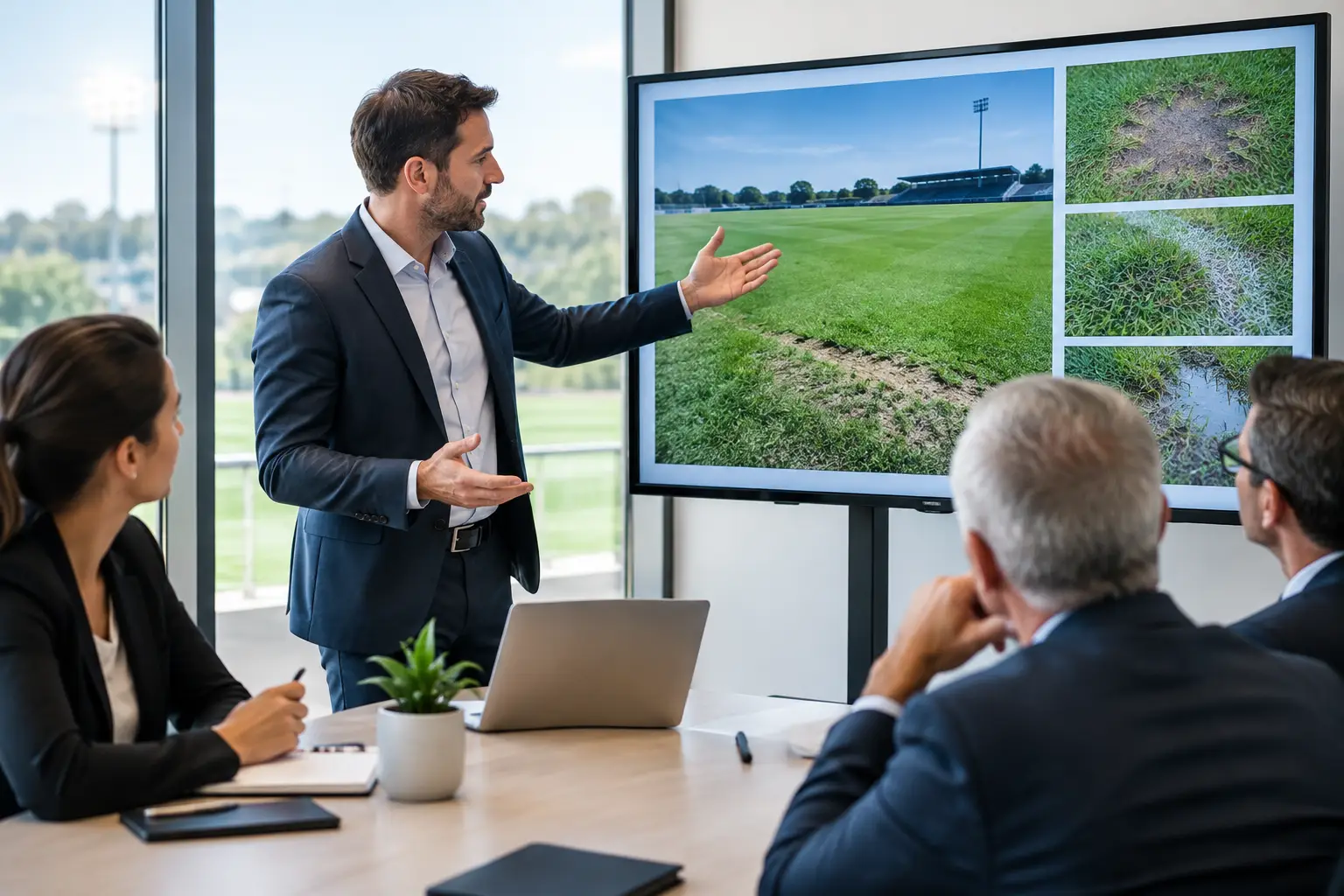
A failing irrigation pump, thinning couch on high-wear areas or a chemical register with gaps can look like separate maintenance issues. To a board, they are business risks with the potential to affect member satisfaction, revenue, compliance and capital budgets. Knowing how to present turf risks means translating what the turf team sees on the ground into decisions directors can make with confidence.
The goal is not to alarm the committee or bury it in technical detail. It is to establish the condition, quantify the exposure, show the consequence of inaction and recommend a practical response with a clear owner and timeframe.
Start with the risk, not the turf jargon
Boards do not need a lesson in soil science before they approve a drainage programme. They need to understand what could happen, how likely it is, what it will cost and what decision is required.
Lead with a plain-English risk statement. For example: “The ageing mainline and pump controls create a high risk of irrigation failure during peak summer demand, which may lead to turf loss on priority playing surfaces, emergency repair costs and reduced member access.” That is far more useful than reporting that the pump has low pressure or that several solenoids are unreliable.
A sound statement identifies the asset or condition, the event that may occur and the operational consequence. It gives the board a direct line between a technical issue and the club’s exposure.
Avoid presenting turf risks as complaints about resourcing. If labour hours, equipment condition or contractor availability are part of the issue, frame them as capacity constraints against a defined standard. A board can act on a measurable gap. It cannot act on a vague sense that the team is under pressure.
How to present turf risks with evidence
Credibility comes from evidence that is current, relevant and easy to verify. A risk report should separate observed facts from assumptions and supplier opinions. Independent advice is particularly valuable where a recommended project involves significant capital expenditure or recurring product costs.
Use the evidence that best fits the risk. For irrigation, this may include water-use trends, pump run times, pressure testing, distribution-uniformity results, repair history and forecast demand. For turf decline, include photographs taken from the same locations over time, surface firmness or moisture readings, disease incidence, soil test results and player feedback patterns. For chemical compliance, use records of storage, labels, training, application logs and any identified non-conformances.
Do not overload the report with every available reading. Two or three decisive measures are usually stronger than pages of raw data. A board should be able to see the trend, understand why it matters and ask informed questions without needing to interpret technical spreadsheets.
Photographs are useful when they are dated, located and paired with commentary. A bare patch by itself proves little. A sequence showing progressive wear at a bowling green entry point, alongside usage figures and a proposed traffic-management measure, shows cause, consequence and control.
Set a clear risk rating
A simple likelihood and consequence matrix provides discipline. Rate likelihood from rare to almost certain, then assess consequence across playing quality, safety, compliance, reputation and financial impact. The overall rating should reflect the most material credible outcome, not the best-case scenario.
Consistency matters more than complexity. If a failed irrigation controller is rated high one month, a comparable electrical fault should not be rated low the next simply because it sits in a different budget line. Establish agreed definitions, apply them consistently and review ratings when conditions change.
For many facilities, a useful threshold is straightforward: high and extreme risks require a defined treatment plan, named accountability and board visibility. Moderate risks remain on the operational register with review dates. Low risks should still be recorded where they reveal a recurring pattern or future capital need.
Put a dollar value on delay
Turf risks gain attention when their commercial implications are made clear. This does not mean inventing precise figures where information is limited. It means setting out reasonable cost ranges and explaining the assumptions behind them.
Consider the full cost of failure. A deferred irrigation upgrade may appear to save capital this financial year, but a summer failure can create emergency contractor costs, water wastage, lost turf, temporary closures and a larger reinstatement project. A mower replacement deferred beyond its economic life can result in poorer presentation, repair downtime, hire charges and additional labour.
Show the board two or three realistic pathways. The first is planned intervention, including scope, cost and timing. The second is managed deferral, with the controls needed to reduce exposure and a point at which the decision must be revisited. The third, where relevant, is failure response, including likely emergency cost and disruption.
This approach prevents a false choice between spending now and spending nothing. Deferral is an active decision with a cost and a risk profile. In some cases, it is entirely reasonable. If a drainage issue can be managed through seasonal programming and targeted works for another 12 months, that may be the right financial decision. The board simply needs to accept the residual risk knowingly.
Link every risk to playing outcomes
The strongest reports connect turf condition to the facility’s purpose. Golf clubs should relate risks to surface consistency, pace, presentation, cart access and competition readiness. Bowling clubs should focus on green performance, player safety and the ability to maintain reliable playing conditions through the season. Councils and sports venues may need to prioritise field availability, booking income, community access and public liability exposure.
This connection is particularly valuable when boards are balancing competing demands. A new clubhouse initiative may be visible and attractive, while irrigation renewal remains below ground. Presenting the likely impact on playable hours, member experience and operating cost gives the less visible project its proper strategic weight.
Be precise about priority areas. Not every hectare needs championship-level input at all times. Identify the surfaces that protect revenue, member expectations, safety and the venue’s reputation. This allows capital and maintenance resources to be directed where failure has the greatest consequence.
Recommend action, ownership and review dates
A risk report without a recommendation becomes a discussion paper. Each significant item should finish with a specific request: approve a diagnostic investigation, release funds for renewal, adopt a revised maintenance programme, appoint a contractor or accept a documented residual risk until a stated date.
The recommendation should identify the responsible person, the required budget, the target completion date and the measure that will confirm success. For example, an irrigation risk may be closed only after pressure testing confirms performance across nominated priority zones. A compliance risk may remain open until records, storage controls and staff training have been audited.
This is where accountability protects both the board and the operational team. Ground staff should not be left carrying responsibility for a known capital or staffing shortfall they cannot resolve. Equally, a board should be able to see whether approved actions have been completed and whether the underlying risk has actually reduced.
At Gen1 Sportsturf, this is the discipline behind board-level turf reporting: independent assessment, a practical action plan and clear follow-through rather than a report that sits unread after the meeting.
Use a reporting rhythm that prevents surprises
Most turf risks become expensive because warning signs were visible but not escalated early enough. A regular reporting rhythm gives directors visibility before conditions become critical.
Monthly operational reporting may track open high risks, completed actions, water use, key maintenance activities, budget variance and seasonal issues. Quarterly board reporting can take a broader view of asset condition, capital priorities, compliance status and emerging risks over the next 12 to 36 months. Following major weather events, pest outbreaks or equipment failures, provide a short exception report rather than waiting for the next scheduled meeting.
Keep the format stable. When the same risk register, ratings and action columns appear each month, changes are immediately visible. Directors can focus their time on decisions instead of relearning the report structure.
Prepare for the questions a board will ask
A well-prepared presentation anticipates scrutiny. Directors are likely to ask whether the risk can be deferred, whether an alternative solution exists, what happens if the recommended work is not approved and how performance will be measured afterwards. These are reasonable governance questions, not resistance.
Answer directly and distinguish between known facts and professional judgement. If the budget estimate is preliminary, say so and recommend the next step needed to refine it. If weather may alter timing, explain the seasonal window and the consequence of missing it. Clear limits build more trust than overstating certainty.
The best turf risk presentation leaves the board with a decision they can defend: the evidence is clear, the cost of action and inaction is understood, and someone is accountable for the next move. That is how turf management earns its place as a strategic operating function, not a line item to revisit only when the surface fails.