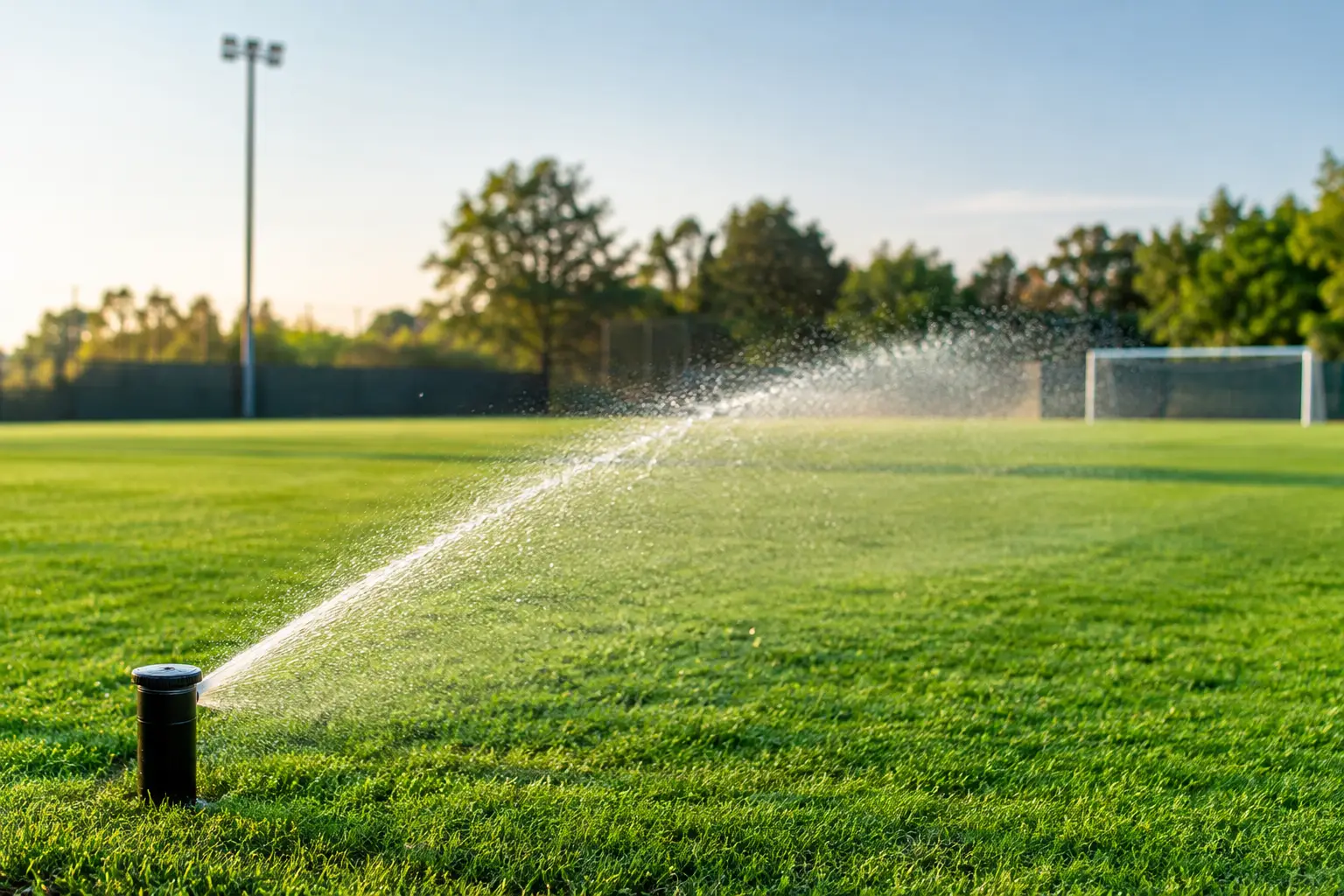
A facility can reduce its water bill and still damage the asset it is trying to protect. That is why irrigation savings should never be measured only by megalitres used or dollars removed from a budget line. For golf clubs, bowling clubs, councils and sports venues, the objective is to apply the right volume of water, in the right place, at the right time, while maintaining safe, consistent and playable turf.
The distinction matters. Cutting run times across every station may produce an immediate reduction in consumption. It can also create dry patch, weakened turf cover, surface inconsistency, greater weed pressure and a larger recovery cost later. Real savings come from control, measurement and accountability - not blanket restriction.
Why irrigation savings are an operational issue
Water is one of the largest controllable inputs in sports turf management, but it does not operate in isolation. Irrigation decisions affect labour, fertiliser response, chemical performance, disease risk, machinery access, member experience and the life of the irrigation system itself.
A poorly managed system usually wastes money in more than one way. Water may be applied to areas that do not need it, while high-value surfaces remain under-watered because of poor distribution, blocked nozzles, pressure variation or unsuitable programming. Staff then spend additional hours hand-watering, repairing stressed turf and responding to complaints that should have been prevented through better planning.
For a board or general manager, this is a governance issue as much as a technical one. The question is not simply, “Can we use less water?” It is, “Can we demonstrate that water is being managed against a defined standard, with clear evidence of savings and no avoidable decline in surface quality?”
Start with a water baseline, not a target
An arbitrary reduction target is rarely a sound starting point. A 15 per cent cut may be achievable at one site without consequence, while the same target could compromise another facility with sand-based profiles, high traffic, poor water quality or limited system capacity.
The first task is to establish a baseline. This should account for total water use, cost per kilolitre, irrigation run times, rainfall, evapotranspiration, soil type, turf species, playing demand and the area actually being irrigated. It should also identify where the water is sourced. Mains supply, dam storage, recycled water and bore water each carry different costs, quality risks and operating constraints.
Once the baseline is clear, management can separate necessary water use from avoidable water use. That creates a defensible target. A club may find its immediate opportunity lies in reducing overwatering of roughs and out-of-play areas. A council facility may discover that pressure issues are causing uneven coverage across several fields. A bowling club may need to focus on improving uniformity around the green rather than reducing total application.
The best target is site-specific and linked to performance measures. These may include water use per irrigated hectare, water use against seasonal demand, hand-watering hours, dry-patch incidents, turf recovery time and playing-surface complaints.
Audit the system before changing the programme
Irrigation programmes often receive attention because they are visible and easy to change. The system’s physical performance deserves equal scrutiny. If distribution is poor, a shorter programme simply redistributes the problem.
A practical irrigation audit examines controller settings, flow data, station run times, pressure, nozzle condition, sprinkler spacing, coverage overlap, leaks, valve operation and pump performance. It also compares actual precipitation rates with the assumptions used in the irrigation schedule.
This work regularly exposes expensive blind spots. A broken or mismatched nozzle can create a dry corridor that staff compensate for by extending the entire station. A pressure issue can leave one end of a green or field dry while the other end receives excess water. A leaking mainline may not be obvious above ground, yet it can steadily increase consumption and pump operating costs.
Uniformity testing is particularly valuable on high-value areas. Catch-can testing provides evidence of how evenly water is applied and identifies whether the issue is design, pressure, maintenance or programming. It is not glamorous work, but it gives management a factual basis for prioritising repairs and capital expenditure.
Fix low-cost faults first
Not every irrigation improvement requires a major capital project. In many cases, the fastest return comes from routine corrective work: replacing worn nozzles, correcting head alignment, clearing obstructions, repairing leaks, checking filters, recalibrating flow sensors and adjusting pressure regulation.
These tasks should sit within a planned maintenance programme, not rely on staff noticing a problem during a busy week. A disciplined inspection routine protects water efficiency and reduces the risk of system failures during periods of peak heat or heavy fixture demand.
Schedule to plant demand, not the calendar
Fixed daily schedules are convenient, but turf does not consume water according to the day of the week. Demand changes with temperature, wind, humidity, rainfall, soil moisture, root depth, shade and traffic.
A stronger approach combines local weather data with on-ground assessment. Evapotranspiration data can inform the replacement requirement, while moisture readings, visual observation and soil inspection confirm whether that requirement matches conditions at the site. Neither source should be used in isolation. Weather-based scheduling can overestimate demand in shaded or sheltered areas, while visual assessment alone can miss declining moisture below the surface.
Deep and infrequent watering is often appropriate for many turf areas because it encourages root development and reduces frequent wetting of the surface. But it is not a universal rule. Sand profiles, newly established turf, shallow-rooted areas and surfaces under acute heat stress may require more frequent, targeted applications. The programme must reflect the profile, turf species and performance standard of each area.
This is where zoning matters. Greens, tees, fairways, bowling greens, sports fields, surrounds and ornamental areas should not be managed as though they have identical needs. Nor should sunny and shaded zones receive the same application simply because they are connected to the same station.
Measure the hidden costs of overwatering
Overwatering is often treated as a water-cost problem. Its wider cost is more significant. Excess moisture can reduce oxygen in the rootzone, increase disease pressure, soften playing surfaces, limit machinery access and encourage shallow rooting. It can also increase nutrient loss and create conditions where more chemical intervention is required.
There is a commercial consequence. A soft fairway, inconsistent green, stressed bowling surface or closed field affects player satisfaction and venue revenue. Repeated surface failures also consume staff time that should be directed towards planned maintenance and improvement work.
A useful monthly report should therefore show more than water consumption. It should link usage to rainfall, weather demand, irrigation faults, agronomic observations, labour spent on hand-watering and the condition of priority surfaces. This makes the operational story clear for both the turf team and the board.
Treat capital decisions as business cases
Ageing irrigation infrastructure can become a false economy. A facility may defer replacement to avoid capital expenditure, then absorb escalating water, labour and repair costs while accepting declining surface consistency.
That does not mean every system needs full replacement. The right option depends on condition, water source, expected asset life, budget capacity and the performance gap. A staged upgrade may offer better value, starting with pump controls, central control capability, flow monitoring, high-priority valve groups or the most inefficient heads.
Each proposal should be assessed as a business case. What is the expected reduction in water use? What labour is removed? What risks are reduced? What happens to turf quality during drought restrictions or peak summer demand? What is the cost of doing nothing for another three years?
Independent assessment is valuable here because recommendations should be based on the facility’s needs, not a product sales target. Clear scope, measurable outcomes and post-installation verification are essential. A new controller does not create savings if the irrigation strategy and field execution remain unchanged.
Give staff a clear operating standard
Even the best system will underperform without capable people operating it. Ground staff need practical direction: what to inspect, what readings to record, when to hand-water, when to adjust a programme and when an issue must be escalated.
This does not require turning every team member into an irrigation designer. It requires a simple operating standard, regular mentoring and clear accountability. Daily checks should focus on priority surfaces and visible failures. Weekly checks can review weather, moisture trends and system faults. Monthly reviews should assess water use, budget position and improvement actions.
For under-resourced facilities, senior oversight can provide the discipline that is otherwise lost between urgent daily tasks. The aim is not to add paperwork. It is to give the existing team a repeatable process that protects the turf asset and provides management with reliable information.
Water will remain a major operating cost and, in many regions, a reputational issue. The facilities that achieve lasting irrigation savings will not be those that simply water less. They will be the ones that manage every litre with the same discipline they apply to safety, budget control and playing-surface standards.