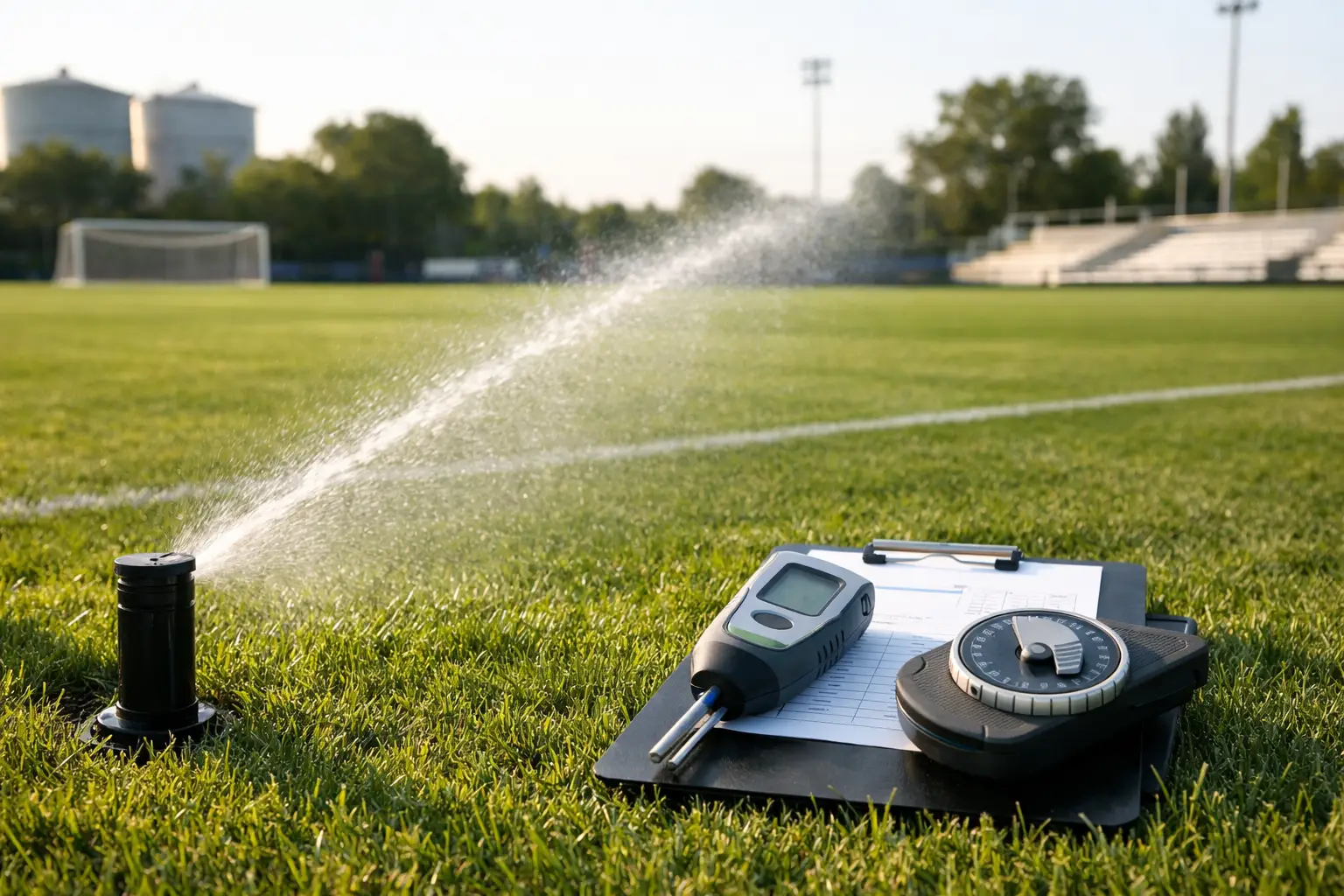
A restriction notice can turn a sound irrigation programme into a high-stakes operational problem overnight. For a golf club, bowling club or public sports facility, the issue is not simply using less water. It is deciding where every permitted litre delivers the greatest return in turf health, playability, safety and asset protection. Effective water restriction planning gives management and ground staff a documented, defensible method for making those decisions before conditions deteriorate.
The facilities that cope best through dry periods do not rely on last-minute hand watering or broad instructions to “cut back”. They have clear priorities, reliable site information, trained staff and authority to act. That is the difference between managing a restriction and watching turf quality, member confidence and future recovery costs decline.
Water restriction planning starts with asset priorities
Not every hectare of turf has the same operational value. Treating the whole site equally is one of the fastest ways to waste a limited allocation. Water restriction planning must begin by ranking surfaces according to their role, replacement cost and consequence of failure.
For a golf course, putting greens, key surrounds, tees, high-traffic fairway landing areas and selected presentation zones will usually sit at the top of the hierarchy. On a bowling green, the playing surface and its uniformity are non-negotiable, while peripheral turf can be managed to a leaner standard. For councils and sports venues, the priority may be competition fields, wicket tables, goalmouths, run-ups and surfaces that carry heavy programmed use.
This is not an argument for allowing secondary areas to fail. It is an argument for setting a realistic survival standard where water is scarce. A dry rough, outfield or landscape area may be acceptable for a period. Losing grass cover on a green, bowling rink or heavily used playing field can trigger far greater cost, disruption and reputational damage.
The priority map should be agreed by the course manager or head greenkeeper, general manager and relevant committee or council representative. Once restrictions are in force is the wrong time to debate whether the practice fairway matters more than a tournament tee complex.
Establish the numbers before the restriction arrives
A water plan built on assumptions will not stand up under pressure. Decision-makers need to know the site’s actual water position: available supply, storage capacity, irrigation system performance, current demand and the minimum requirement for priority surfaces.
Start with a practical water balance. Record all supply sources, including potable water, dams, bores, recycled water and harvested stormwater. Confirm licence conditions, extraction limits, local restriction rules and any water-quality constraints. A bore that produces adequate volume but carries salinity risk is not an unlimited drought solution. Nor is a dam that appears full if it cannot support the required drawdown through the dry period.
Then measure usage by zone where meters allow it. If the site has only a main meter, temporary monitoring and controller run-time analysis can still identify the major demand areas. The objective is to replace guesswork with a credible baseline. Boards should be able to see how much water the facility uses in normal operation, what can be reduced without material risk, and where the break point sits.
Audit irrigation performance, not just water use
An irrigation system can consume significant water and still leave turf under stress. Distribution uniformity, pressure variation, nozzle wear, blocked heads, poor head spacing, valve faults and controller programming errors all affect the result. Under restrictions, those inefficiencies become more expensive.
A catch-can assessment on critical zones can expose whether the programmed application matches the water reaching the surface. Soil moisture monitoring and regular probing provide the second part of the picture. Turf does not respond to litres applied. It responds to moisture available in the rootzone.
This distinction matters particularly on variable soils. A heavy profile may hold moisture longer but become prone to shallow rooting if watered too frequently. Sand-based surfaces may require shorter, more precise applications and targeted hand watering. The correct programme depends on soil, species, weather, root depth, shade, traffic and the condition of the irrigation network.
Build a staged response, not one blanket rule
Water restrictions often escalate. A facility needs defined triggers for each stage rather than a single drought plan that is either ignored or too severe to use. Staged planning protects turf early, when modest adjustments can preserve water and maintain plant health.
At the first stage, the focus may be on eliminating waste: repairing leaks, reducing irrigation on low-value areas, suspending cosmetic watering, reviewing run times and moving irrigation into approved watering windows. The turf team should also increase inspection frequency. Dry spots, runoff and hydrophobic soils need targeted action before they become large-scale decline.
At a more severe stage, the plan may reduce the irrigated footprint, move to priority-zone scheduling and increase hand watering on high-value surfaces. Cultural practices also need adjustment. Raising mowing heights slightly, reducing unnecessary grooming, moderating fertiliser inputs and managing traffic can lower stress. The aim is to retain healthy, functional turf rather than chase peak visual presentation during conditions that cannot support it.
At the highest stage, the facility may need to protect core playing surfaces only, alter event programming and communicate temporary expectations to users. These decisions are commercially difficult, but delaying them can compound the cost. A closed or restricted area is often preferable to a surface that fails and requires extensive renovation.
Give staff clear authority and daily controls
A plan is only useful if the people operating the site can execute it. Under-resourced teams should not be expected to interpret a broad policy while dealing with heat, member expectations and competing tasks.
Daily responsibilities should be clear: who checks soil moisture, who reviews the controller, who authorises hand watering, who records water use and who escalates a developing issue. Keep records simple enough to maintain during busy periods. A daily log of irrigation hours, rainfall, temperature, moisture observations, hand-watered locations and faults provides valuable evidence for operational reviews and board reporting.
The same discipline applies to contractors and volunteers. If multiple people can alter irrigation settings without a defined approval process, water restriction planning will unravel quickly. One accountable operational lead should control the programme, supported by documented instructions and regular review.
Manage expectations before turf appearance changes
Members, players, elected representatives and neighbouring residents will notice dry turf. They may not understand that dormant or lightly stressed turf can be a deliberate management outcome, while overwatering a secondary area may put the primary playing surface at risk.
Clear communication turns a perceived decline in standards into evidence of responsible stewardship. Explain the restrictions, identify the surfaces being protected, state any changes to play or access, and be honest about what recovery may require when conditions improve. Avoid promising a rapid return to normal appearance if water supply, weather or turf health does not support it.
For boards and committees, reporting should connect technical choices to commercial outcomes. Include water use against allocation, irrigation repairs completed, priority-surface condition, expenditure, identified risks and decisions required. That creates accountability and helps prevent reactive spending on temporary fixes that do not address the underlying system.
Recovery requires as much discipline as restriction
When rain arrives or restrictions ease, the temptation is to restore every area immediately. That can be as inefficient as watering too freely during the dry period. Recovery should be based on inspection, moisture data, turf response and the site’s revised water position.
Priority surfaces may need aeration, wetting-agent programmes, nutrition, pest and disease monitoring, overseeding or targeted renovation. Secondary areas may recover naturally if turf crowns and root systems remain viable. Some will need staged repair. The correct response depends on the level of damage, seasonal growing conditions and available budget.
This is also the point to review the plan. Were water priorities correct? Did the irrigation system deliver where it was needed? Were staff able to act quickly? Did reporting give management confidence? Each restriction period should leave the facility with better data, tighter systems and fewer avoidable risks for the next one.
For clubs, councils and sporting venues, water is not merely a utility cost. It is a critical input that protects revenue, community access and the condition of valuable playing assets. A disciplined plan gives every decision a purpose when supply is constrained, and gives boards confidence that turf standards are being managed with both expertise and financial control.