A green does not need renovation because the calendar says so. It needs renovation when performance, plant health and the underlying profile show that normal maintenance is no longer correcting the problem. For boards and managers asking when should greens be renovated, the answer should be based on evidence, recovery capacity and the cost of doing nothing.
Renovation disrupts play and requires a clear budget. Delaying a necessary programme, however, can be far more expensive. Thin turf, poor infiltration, excessive thatch and uneven surfaces drive member dissatisfaction, increase labour and chemical inputs, and leave the course exposed when heat, traffic or disease pressure arrives.
Renovation is a performance decision, not an annual ritual
Many clubs treat renovation as a fixed autumn or spring event. Timing matters, but a routine is not a diagnosis. Some greens require significant intervention every year; others need a lighter programme because the profile is stable, the turf is healthy and organic matter is under control.
The right decision starts with a practical assessment of surface firmness, smoothness, infiltration, root depth, thatch, organic matter, species composition and irrigation performance. Green speed alone is not a measure of green health. A fast surface with shallow roots, dry patch and a sealing profile is not performing well. It is carrying risk.
For golf facilities, renovation should protect the putting surface through the busiest playing periods while restoring the conditions required for reliable year-round performance. That means matching the scale of work to the problem, rather than applying aggressive cultivation simply because it has always been done.
The signs that greens need renovation
Water is no longer moving through the profile
Slow infiltration is one of the clearest indicators. If water sits on the surface after irrigation or rainfall, or if the green becomes soft and unstable despite conservative watering, the upper profile may be sealing. Excess organic matter, fine particles, layering and compaction can all restrict air and water movement.
The operational consequence is significant. Staff often respond by watering more frequently or applying wetting agents more heavily, yet the underlying issue remains. Roots become shallower, disease risk rises and the surface can swing between wet softness and localised dry patch. Core aeration, sand topdressing and, where necessary, more substantial profile work may be required to restore infiltration.
Thatch and organic matter are affecting firmness
A small amount of organic matter is necessary. Excessive accumulation is not. A spongy surface, deep ball marks, mower scalping and inconsistent firmness are common symptoms of an organic layer that has outpaced the club's dilution programme.
Organic matter should be measured rather than guessed. Soil testing and profile inspection provide the evidence needed to determine whether routine hollow coring, solid tine aeration, scarifying or deeper renovation is justified. This gives management a defensible basis for scheduling works and explaining temporary disruption to members.
Turf density is declining or the surface is becoming uneven
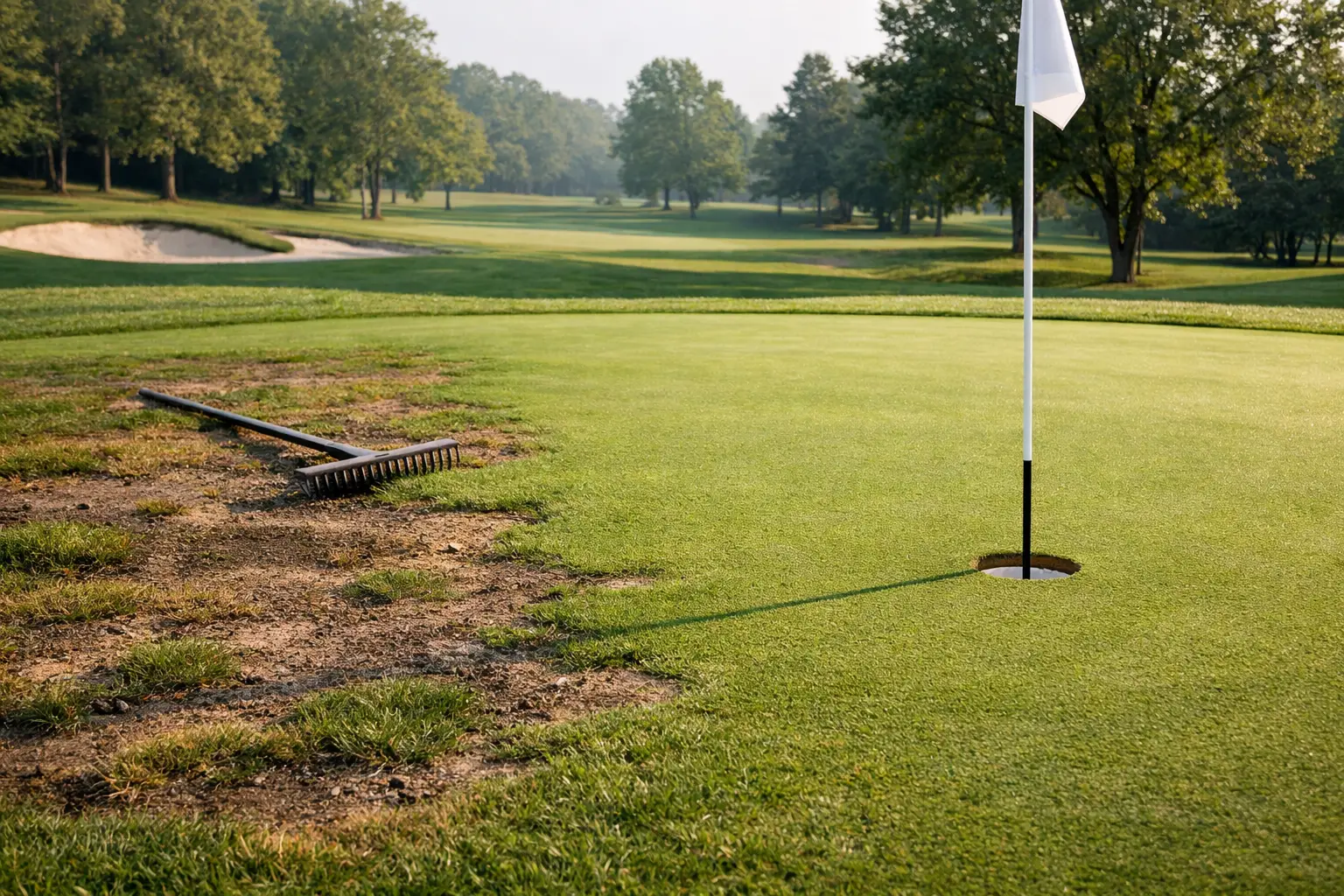
Thin turf is rarely just a cosmetic issue. It can point to shade, traffic, poor nutrition, disease history, irrigation distribution problems, unsuitable mowing practices or rootzone limitations. If bare areas repeatedly return after patching, the facility must identify the cause before spending money on seed, turf or chemicals.
Likewise, persistent bumpiness and loss of trueness can signal thatch, surface layering, damage from equipment or a declining turf stand. Light topdressing may correct minor issues. More pronounced defects may need cultivation, levelling and a recovery plan that accounts for the playing calendar.
Roots are shallow when the surface is under stress
Healthy roots give a green tolerance. They help the turf manage heat, wear and short periods between irrigation cycles. Shallow roots leave little margin for error, particularly through Australian summer conditions.
Root depth should be checked across multiple greens, not judged from one favourable location. If roots consistently stop at a compacted or saturated layer, renovation may be part of the answer. It must also be supported by changes to irrigation scheduling, fertility, mowing and traffic management. Renovating a green while retaining the practices that caused the issue is an expensive loop.
Disease, weeds or species change are becoming chronic
Recurring disease is often blamed on weather, but poor airflow, leaf wetness, excessive nitrogen, weak roots and organic matter accumulation frequently contribute. Renovation can improve the growing environment, but it is not a substitute for disciplined cultural management.
Changes in turf species also deserve attention. Poa annua invasion, weak bentgrass density, encroaching couch or contamination from unsuitable grasses can alter playing quality and maintenance costs. A renovation window may be the right time to oversow, interseed or undertake a more deliberate conversion strategy. The scale of work depends on the desired species, climate, budget and the club's tolerance for disruption.
When should greens be renovated in Australia?
The best window is when turf has sufficient growing capacity to recover promptly, not merely when competition schedules are quiet. This varies by location, grass type and the level of intervention required.
Cool-season greens in Victoria and cooler parts of New South Wales often respond well to autumn renovation, when soil temperatures support recovery and summer stress has passed. Spring can also work, though clubs should weigh the risk of entering warmer weather with an immature surface.
For warm-season couch greens across Queensland and northern New South Wales, late spring through summer generally provides stronger recovery conditions. Renovating too late in autumn can leave the surface slow to heal as growth falls away. In tropical or subtropical environments, rainfall patterns, heat load and disease pressure must also shape the programme.
There is no universal date. A club should review historical weather, turf growth, event commitments and staffing capacity before locking in work. The correct window for hollow coring may differ from the best window for aggressive scarifying, topdressing, fumigation, resurfacing or species conversion.
Choose the least disruptive work that solves the problem
Renovation does not automatically mean full hollow coring. A sound programme may combine light and frequent sand topdressing, needle tining, solid tining, grooming, verticutting and targeted coring across the year. This approach can maintain gas exchange and dilute organic matter with less interruption to play.
Where the profile is heavily layered, organic matter is excessive or drainage failure is evident, lighter methods may simply postpone the problem. More aggressive work can be commercially justified when it prevents repeated reactive spending and protects member experience over the longer term.
The key is to set measurable objectives before work begins. These might include infiltration rates, organic matter targets, root depth, surface firmness, turf cover and recovery time. Without targets, the club cannot judge whether the programme delivered value or merely created short-term disruption.
Build renovation into the operating plan
A successful renovation programme requires more than machinery and sand. It needs a documented scope, a budget, clear staff responsibilities and a member communication plan. Timing should account for major competitions, school holidays, contracted works, irrigation availability and the recovery time required before surfaces return to acceptable presentation.
Boards should also ask whether the club has enough data to make the decision confidently. Basic profile testing, moisture monitoring, irrigation audits and photographic records can turn a subjective discussion about ‘tired greens’ into an accountable investment decision. They also help distinguish a turf issue from a water, shade, drainage or staffing issue.
Gen1 Sportsturf approaches renovation planning as part of a broader performance system: diagnose the constraint, specify the right intervention, support the ground team through execution and report the outcome against agreed standards. That protects both playing quality and capital allocated to the course.
The most useful question is not whether renovation will inconvenience golfers for a few days. It is whether the club can afford another season of declining roots, inconsistent surfaces and reactive maintenance. Act while the turf still has the capacity to recover, and make every renovation dollar solve a defined problem.