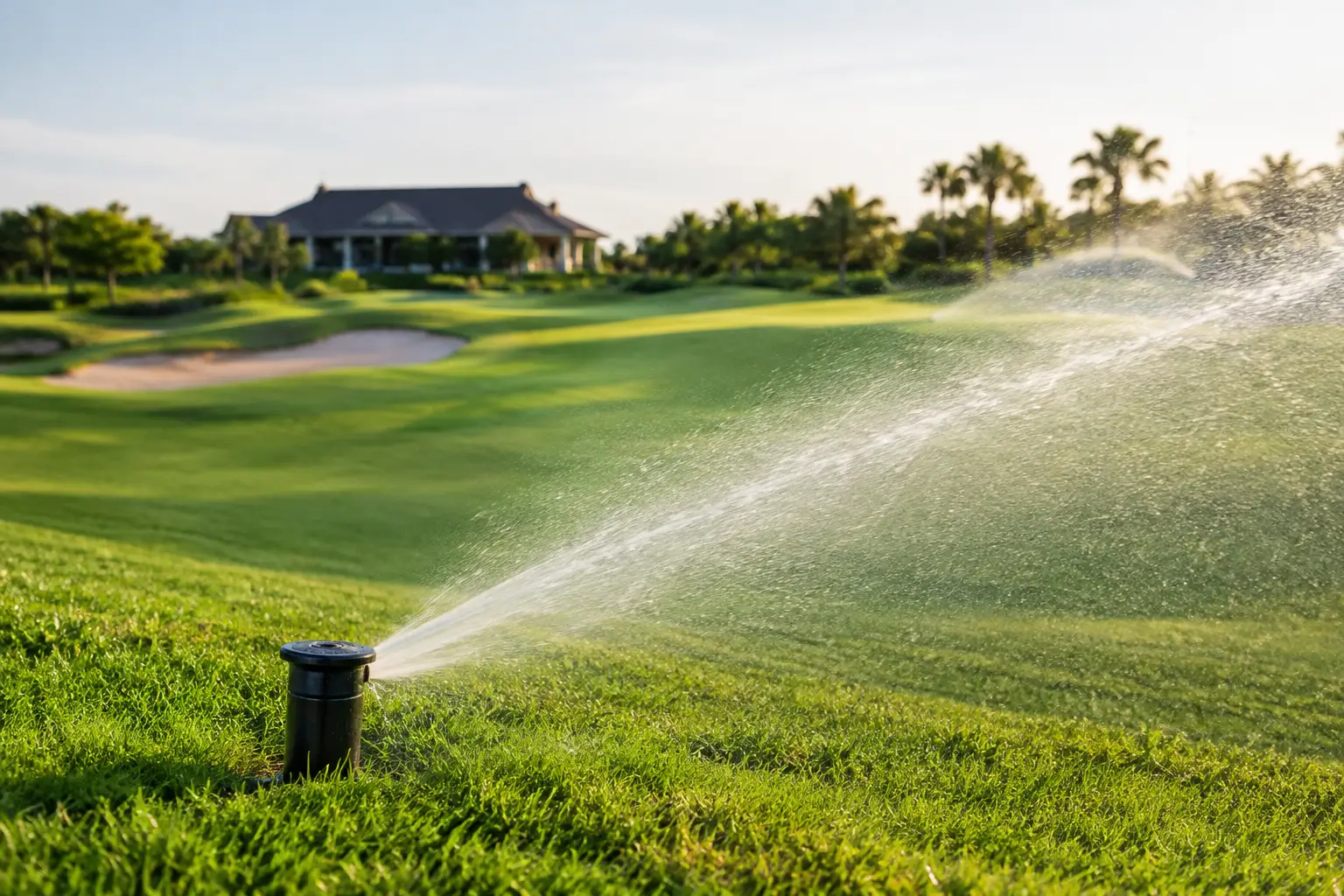
A brown patch beside a green is visible. A poorly programmed irrigation system is not. That is why golf clubs waste water: not because every course is careless, but because water use is often managed as a daily operational task rather than a measured business risk. When irrigation decisions are based on habit, visual judgement and inherited settings, excess water can be applied for months before anyone sees the true cost.
For Australian clubs, the exposure is substantial. Water pricing, allocation limits, pumping power, ageing infrastructure and rising member expectations all place pressure on the course budget. Overwatering also creates an agronomic cost. It weakens turf resilience, encourages disease, increases nutrient loss and can leave playing surfaces softer and less consistent than members expect.
The practical issue is not simply using less water. It is applying the right amount, in the right place, at the right time, with clear accountability for the result.
Why golf clubs waste water
Water waste is rarely caused by a single broken sprinkler or one poor decision. It usually develops through a combination of system limitations, weak planning and an absence of reliable data. The course may look adequately presented, yet the operation can still be paying for water it does not need.
Irrigation schedules are inherited, not managed
Many clubs operate irrigation programmes that have evolved over years. Run times are adjusted after a hot week, increased after member complaints or retained because they have always been used. The schedule becomes the system, even when rainfall, evapotranspiration, soil moisture and turf demand have changed.
This approach is understandable in an under-resourced maintenance team. Staff need to get through a full workload, and irrigation is often controlled early in the morning or late in the day when there is little time for analysis. But a fixed schedule is not a water budget. Without a deliberate review, a course can keep applying peak-summer volumes well into periods when turf demand has fallen.
The key question is not whether the irrigation ran. It is whether the applied volume matched the actual moisture deficit in each managed area.
The system delivers unevenly
An irrigation controller can report that every station has run exactly as programmed. That does not mean water has been distributed evenly across the turf.
Pressure variation, worn nozzles, blocked filters, misaligned heads, poor head spacing, damaged valves and changes to landscaping all affect distribution uniformity. One dry area can lead staff to extend a whole irrigation zone, overwatering most of the area to keep a small problem patch alive. That is one of the most common forms of hidden water waste on established courses.
A proper catch-can assessment and pressure audit identify whether the system is delivering the water the programme assumes it is delivering. This work is less glamorous than installing new technology, but it is often where the first savings are found. Better uniformity allows shorter run times and reduces the need for broad corrective watering.
Courses are watered by zone, not by need
Greens, tees, fairways, surrounds, practice areas, roughs and ornamental spaces do not have the same water requirement. Neither do all parts of a fairway. Shaded ground, compacted soil, sand profiles, exposed ridges and low-lying areas can perform very differently within the same irrigation zone.
When a large zone is treated as one uniform surface, the wettest areas receive too much water to protect the driest. The result is familiar: soft ground, disease pressure, weak rooting and a continued dependence on irrigation.
This is where agronomy and irrigation design must work together. Soil moisture testing, infiltration observations, turf species, root depth and traffic patterns should guide decisions. If the only measure is whether turf remains green from a distance, the club is likely applying more water than required.
Manual watering becomes a substitute for diagnosis
Hand watering is an essential tool on quality golf surfaces. Used well, it is precise, responsive and far more efficient than increasing automatic run times across an entire area. Used without a plan, it becomes a symptom-management exercise.
If staff are repeatedly hand watering the same locations, the cause needs investigation. It may be poor coverage, hydrophobic soil, compaction, shallow roots, tree competition or a hydraulic issue. Adding more water may keep turf alive temporarily, but it does not correct the underlying constraint.
Clubs should treat recurring hand-watering locations as operational data. Mapping them over a season provides a clear priority list for irrigation repairs, soil treatment, drainage work or agronomic change.
Water use is not measured against a meaningful benchmark
Many boards receive a water account after the fact, usually as part of monthly financial reporting. By then, the water has been used and the cost absorbed. A bill can show that expenditure rose, but it cannot explain whether the cause was weather, a leak, poor scheduling, surface expansion or equipment failure.
Useful water management requires a baseline. This should include total consumption, consumption by source where relevant, pumping costs, rainfall, irrigated area and seasonal demand. It should also distinguish between course irrigation, washdown, clubhouse use and other operational demand where metering permits.
Without this information, management cannot separate a necessary summer increase from avoidable consumption. Decisions then become subjective, and it is difficult for a superintendent, course manager or greenkeeping team to demonstrate that they are managing the resource responsibly.
The cost is larger than the water bill
Excess irrigation is often discussed as an environmental issue, and it is one. For club boards, however, the more immediate case for action is operational and financial.
Every unnecessary kilolitre can carry a pumping cost, treatment cost or supply charge. It also contributes to labour demand, chemical use and machinery traffic. Wet turf may require more disease intervention. Softer surfaces can be more vulnerable to wear. Poorly managed irrigation can also create member dissatisfaction when greens lack firmness, bunkers wash out or fairways become persistently boggy.
There is a risk-management dimension as well. In regions facing tighter water restrictions or uncertainty around supply, inefficient use reduces a club's room to respond. A course that has no accurate water budget, no verified irrigation performance and no documented drought plan is exposed when conditions turn quickly.
Not every reduction target is sensible. During establishment, renovation recovery, heat stress or severe drought, targeted water use may need to increase to protect a valuable turf asset. The commercial objective is not arbitrary reduction. It is avoiding waste while protecting playing quality and long-term turf health.
A disciplined approach to reducing water use
The strongest results come from treating water as a managed input, not an automatic utility. The first step is to establish a practical baseline: meter readings, water source, pump hours, rainfall, irrigated hectares and seasonal cost. This creates a starting point for decisions and board reporting.
Next, test the irrigation system in the field. Review pressure, nozzle condition, head alignment, station run times, valve performance and distribution uniformity. A controller cannot correct mechanical shortcomings, and a new controller will not solve a poorly performing network.
Then align irrigation scheduling with agronomic evidence. Soil moisture readings, weather data, visual turf response and known problem areas should inform weekly adjustments. The goal is to replace blanket watering with targeted applications that account for different surfaces and microclimates.
Finally, assign ownership. Someone must be accountable for reviewing water use, investigating variances and reporting actions taken. This does not mean burdening a leading hand with a complex spreadsheet. It means setting a simple operating rhythm where irrigation performance is reviewed, exceptions are explained and priorities are funded.
What boards should ask management
Boards do not need to prescribe run times or choose sprinkler nozzles. They do need clear answers to a small number of governance questions. What is the club's annual and seasonal water use? How does it compare with prior years after allowing for weather and irrigated area? Is the irrigation system audited for distribution and leakage? Which areas consume the most water, and what capital works would reduce that demand?
They should also ask whether the course has a documented response for water restrictions, drought and system failure. These are not technical curiosities. They are business continuity questions with direct implications for course condition, member experience and capital planning.
Independent review can be valuable where internal teams are stretched or where irrigation issues have become normalised over time. Gen1 Sportsturf approaches irrigation as part of the wider turf operating plan, linking system performance, agronomy, staff capability and board-level reporting rather than treating water as a standalone cost line.
Water efficiency does not come from asking crews to water less and hope for the best. It comes from giving them a system, a plan and the authority to act on measured evidence. When that discipline is in place, the club protects both its turf asset and its capacity to invest in the course members actually play.