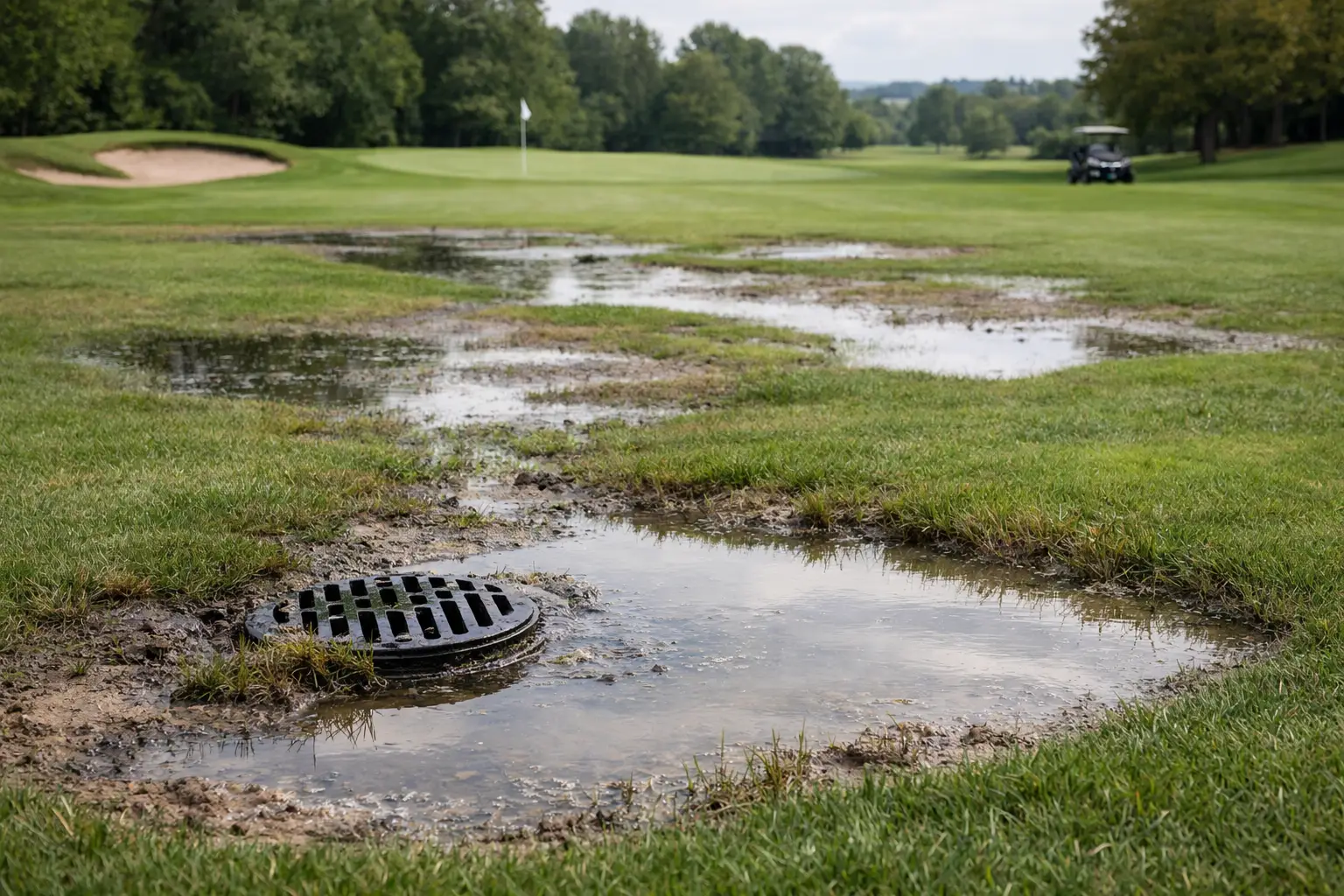
A fairway can look acceptable from the cart path yet be losing playing days, machinery access and member confidence underneath. When boards ask, “why is fairway drainage failing?”, the answer is rarely that one pipe has blocked. More often, the drainage system is being asked to compensate for a soil, surface and water-management problem that has never been properly diagnosed.
For Australian clubs, the commercial impact is immediate. Wet hollows force cart restrictions, reduce competition capacity, delay mowing and expose turf to wear just when recovery is slow. Repeated patch repairs consume labour and budget without resolving the cause. The objective is not simply to move water away faster. It is to restore a fairway profile that accepts rainfall, drains predictably and remains firm enough to support golf and maintenance operations.
Why Is Fairway Drainage Failing? Start With the Profile
A drainage outlet only works if water can reach it. That sounds obvious, but many drainage projects begin with trenching before anyone has established where water is sitting in the soil profile, what layer is restricting movement, or whether the surface actually falls towards the drain.
Fairway drainage commonly fails because of a perched water table. Rain moves freely through the upper rootzone, then reaches a dense clay layer, compacted construction fill or naturally restrictive horizon. Water cannot move downward at the same rate it arrives, so it spreads sideways and rises back into the rootzone. The fairway becomes soft even where surface drains appear sound.
This is particularly common on heavy clay sites, reclaimed land and older course areas that have been modified repeatedly over decades. A new sand slit may improve the first metre of a wet area, but if its depth, spacing and connection to an effective collector drain are wrong, the improvement will be short-lived.
A proper diagnosis starts with soil pits, not assumptions. Inspect the depth of the rootzone, identify texture changes and compaction layers, note mottling or grey soil that indicates prolonged saturation, and measure the level of water after rainfall. Infiltration testing is valuable, but it must be interpreted alongside the soil profile and site levels. A single test result does not explain an entire fairway.
Surface Levels Often Create the Real Problem
Subsurface drainage cannot overcome poor surface water management. If rainfall is ponding in broad, shallow depressions, water will keep entering the profile long after surrounding ground has dried. The result is a familiar cycle: wet conditions, reduced traffic, damage from essential maintenance, then more unevenness and further ponding.
Surface issues are not always dramatic. A fall of only a few centimetres across a fairway can determine whether water moves toward a swale or remains in a low pocket. Settlement over old trenches, construction activity, tree-root disruption and years of topdressing without a grading plan can all alter surface performance.
Before installing more drainage, establish accurate levels across the problem area. Identify where water enters, where it should leave and whether there is a genuine outfall. This is where clubs can avoid a costly mistake: installing lateral drains in a low point with no practical discharge route. Water collected by a drain still needs somewhere to go.
Surface reshaping can be disruptive and requires careful planning around play, but it is often the higher-value intervention. Modest regrading, targeted sand capping or reconstruction of persistent wet hollows may remove the underlying load from the drainage system. The right solution depends on soil type, fall, budget, irrigation coverage and how critical the fairway is to daily play.
Compaction Is Restricting Water Before It Reaches the Drain
Compaction is a drainage issue as much as a turf-health issue. Repeated cart traffic, concentrated machinery routes, wet-weather maintenance and tournament set-up can close pore space in the upper profile. Water then struggles to infiltrate, resulting in surface softness and run-off even when the lower drainage network is functioning.
The warning signs are often visible: wheel ruts that persist, thin turf on traffic lines, puddling beside cart exits and soil that smears rather than fractures when sampled. On warm-season fairways, compaction can also reduce root depth and limit the turf’s ability to tolerate the stress that follows a wet period.
Aeration must match the constraint. Shallow solid tining may assist gas exchange but will not break a deeper compacted layer. Deep tining can create useful channels, but only when soil moisture is suitable and the operation reaches through the restrictive horizon. Sand injection or topdressing can improve the continuity of pore space, provided the material is compatible with the existing profile.
There is a trade-off. Aggressive cultivation during an unsuitable period can damage turf cover, disturb playing surfaces and create short-term mess. But avoiding the work indefinitely leaves staff managing symptoms with fertiliser, fungicides and extra mowing. A planned programme, timed around turf growth and course demand, is more defensible than repeated reactive treatments.
Irrigation May Be Adding to the Load
A fairway can be over-watered even when the irrigation budget appears controlled. Poorly matched nozzles, leaking valves, excessive run times and irrigation scheduled by routine rather than soil moisture all add water to areas already struggling to drain. In humid or high-rainfall periods, the problem is compounded when controllers continue operating as though the profile is dry.
Irrigation audits should examine distribution uniformity, precipitation rates, run times and actual soil moisture across representative locations. The question is not whether heads are operating. It is whether they are applying the right volume, evenly, at a rate the soil can accept.
Run-off from hard surfaces, adjacent roughs or higher fairway ground also needs consideration. A wet fairway may be receiving water from elsewhere. Without mapping these flows, staff can reduce irrigation in the affected area and still see no improvement.
Good irrigation management protects more than water costs. It supports firmer surfaces, reduces disease pressure, improves fertiliser efficiency and gives drainage infrastructure a realistic chance to work as designed.
Drainage Infrastructure Has a Service Life
Older agricultural drains and collector lines can fail through sediment entry, root intrusion, crushed sections, poor joints or inadequate outfalls. In some cases, the original system was never designed for modern traffic loads or changes to surrounding development.
CCTV inspection, flushing and outlet checks should be part of a structured investigation where installed drains are suspected. Do not assume a line is blocked simply because a fairway is wet, and do not assume it is clear because water appears at an outlet. A partial blockage, flat section or damaged connection can restrict capacity significantly during a heavy event.
Drainage works also fail when details are compromised during installation. Incorrect pipe grade, insufficient gravel envelope, contaminated trench backfill and laterals spaced too widely for the soil all reduce performance. These are specification and quality-control issues, not bad luck.
For boards and managers, the key requirement is accountability. Any proposed drainage project should document the diagnosed constraint, design depth and spacing, discharge point, materials, installation controls and expected outcome. A quote for “additional drainage” is not a drainage strategy.
A Better Response Than Repeated Patch Repairs
The most effective course of action is staged. First, document wet areas across different rainfall events and identify their effect on play, machinery access and maintenance hours. Next, inspect surface levels, soil profiles, compaction and irrigation before deciding whether existing drains require investigation.
From there, prioritise work based on operational risk. A recurring wet section on a high-traffic landing area deserves a different response from an isolated low point with minimal impact on play. Some sites need targeted aeration and irrigation correction; others need surface reshaping, new collector drains or a full reconstruction of a failed profile.
This approach controls capital expenditure because it separates quick operational corrections from assets that require design and investment. It also gives the course team clear direction rather than another vague instruction to “get the area dry”.
Fairway drainage is not a standalone maintenance issue. It is a performance, access and asset-management issue that needs the same discipline as irrigation planning or machinery replacement. When the diagnosis is sound, every dollar spent on drainage has a defined purpose - and the ground staff have a practical plan for keeping the improvement in place.