A fungicide application is not a diagnosis. When a green, fairway, bowling surface or sports field starts to decline, the visible symptom is often the last part of the story. This guide to turf disease diagnosis is designed to help facility leaders and ground teams separate pathogen activity from irrigation, nutrition, traffic and soil issues before money is spent on the wrong response.
Why turf disease diagnosis is a management decision
Disease diagnosis is often treated as a technical task for the greenkeeping team. It is also a cost-control and risk-management task for the club, council or facility. A misdiagnosis can lead to unnecessary chemical expenditure, repeated applications, missed playing-quality targets and a preventable decline in plant health.
The pressure to act quickly is understandable. Members see discolouration on a putting surface. Players question the quality of a field. A committee asks why an area that was acceptable last week is now thin or uneven. But a rapid response without sound evidence can compound the problem, particularly where moisture, compaction or poor irrigation uniformity created the conditions for decline.
The standard should be simple: identify the cause, document the evidence, select the lowest-risk effective response, and review the result. That creates accountability for both the treatment decision and the budget behind it.
Guide to turf disease diagnosis: start with evidence
Begin at the site, not in the chemical store. Record when the symptoms first appeared, how quickly they progressed, recent weather, irrigation run times, mowing changes, fertiliser applications, traffic levels and any previous chemical use. A clear timeline often eliminates half the possible causes.
Look closely at the pattern. Disease usually has a distribution that tells a story. Circular patches, expanding rings, distinct foliar lesions or activity concentrated in humid, shaded locations may point towards a pathogen. Uniform discolouration over an irrigation station, stripe patterns following machinery movement, or damage limited to high-wear entrances may indicate an operational issue instead.
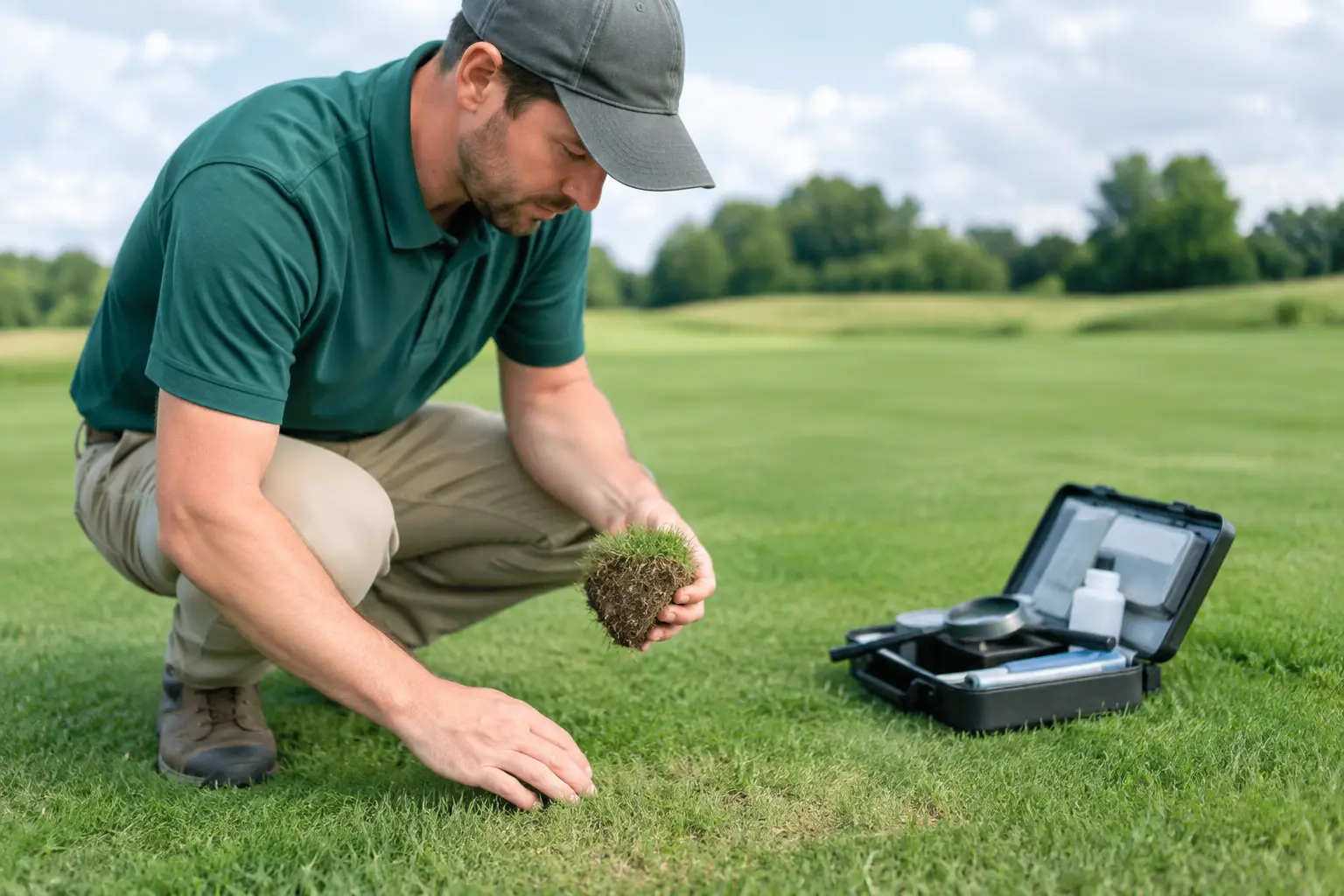
Inspect more than the leaf blade. Pull plugs from the edge of affected turf and from healthy turf nearby. Compare root depth, root colour, thatch moisture, soil smell and compaction. Check whether the crown is firm and alive. Root disease, waterlogging and poor oxygen exchange can produce symptoms that look similar from above, but demand very different action.
Photographs are useful only when they are structured. Take a wide image to show distribution, a mid-range image to show patch shape and a close image of leaves, crowns and roots. Include the date, location and turf species. Repeating this record over several days makes progression visible and provides a defensible basis for reporting to management or a board.
Read symptoms in the context of conditions
No single symptom confirms a disease. Turf disease diagnosis is a process of building and testing a likely explanation.
On cool-season turf, leaf spot and melting-out complexes may begin as defined leaf lesions before thinning becomes obvious. Dollar spot commonly produces small, straw-coloured patches, particularly where leaf wetness persists and nitrogen is marginal. Brown patch is more likely under warm, humid conditions and can move quickly where night-time temperatures remain high and the canopy stays wet.
On warm-season surfaces, large patch, take-all root rot, leaf diseases and Pythium-related decline each require careful differentiation. Take-all root rot may be associated with weak, dark roots and a gradual loss of vigour. Pythium can progress rapidly in saturated or poorly drained profiles, especially during warm, humid weather. Treating either as a simple leaf disease may protect the wrong part of the plant and leave the primary stress unaddressed.
Fairy ring deserves particular discipline. The ring pattern can be visually obvious, but the impact ranges from a cosmetic flush of growth to severe localised dry patch and hydrophobic soil. The management response depends on whether the principal issue is fungal activity, water repellence or both. Wetting agents, aeration and targeted irrigation can be as material to the outcome as any fungicide decision.
Climate matters across Queensland, New South Wales and Victoria. A disease pattern that is likely after a humid summer storm in Queensland may be less likely during a cool Victorian winter. Turf species, surface construction, shade, airflow and the facility's irrigation capability matter just as much. Avoid relying on a calendar diagnosis such as, “it is always this disease at this time of year”. Conditions change, and so should the assessment.
Rule out non-disease causes before treatment
The most expensive diagnosis is the one that ignores basic agronomy. Before committing to a fungicide programme, check irrigation performance and soil conditions. Dry patches can result from blocked nozzles, poor head alignment, inadequate pressure, wind loss or hydrophobic profiles. Excess water can be caused by over-programming, leaking valves, poor drainage or a rain sensor that is not being used correctly.
Nutrition must also be assessed in context. Low nitrogen can increase susceptibility to some diseases, yet excessive nitrogen can create soft growth and increase risk under humid conditions. The correct response is not automatically more fertiliser. It is a measured programme aligned to growth demand, clipping yield, soil or tissue information, and the surface's playing requirements.
Compaction, thatch, shade and poor airflow are recurring contributors. They reduce root function, extend leaf wetness and make disease pressure harder to manage. If a surface needs repeat curative applications, the question for management is not only which product to use next. It is why the disease-conducive environment remains in place.
Confirm the diagnosis before escalating
Field observations can establish a strong working diagnosis, but laboratory testing is worthwhile when symptoms are unusual, the surface is high value, or previous treatments have failed. A laboratory result is particularly useful where multiple stresses are present or where a board needs confidence that a significant chemical or renovation expenditure is justified.
Sample correctly. Collect material from the advancing edge of damage, including healthy and affected turf, roots and soil. Do not send a completely dead plug if the goal is to identify an active pathogen. Keep samples cool, label them clearly and provide the laboratory with the site history. A poor sample can produce an inconclusive result and delay the decision.
Where treatment is necessary, choose it against the confirmed or most likely pathogen, the turf species, the weather window and the product label. Rotate fungicide groups appropriately to reduce resistance risk. Chemical selection, rate, water volume, application timing and post-application irrigation must be recorded. This is chemical compliance, but it is also operational learning. Without accurate records, the team cannot distinguish a product failure from an application, timing or environmental failure.
Build a response plan that the team can execute
A sound disease response has two tracks. The first is immediate containment: reduce unnecessary leaf wetness, correct obvious irrigation faults, manage traffic where practical and apply an approved treatment only when the diagnosis supports it. The second is prevention: improve drainage or airflow, adjust nutrition, refine mowing and grooming practices, relieve compaction, and strengthen monitoring in known risk areas.
For busy facilities, assign clear ownership. The course manager or leading hand should know who inspects the area, who adjusts irrigation, who authorises chemical use and who updates management. Set review dates rather than assuming the job is complete once an application has been made. At review, compare photographs, disease spread, root health, moisture readings and playing quality against the original condition.
A useful site record should capture at least four items:
- location, turf species, symptom pattern and severity;
- weather, irrigation, nutrition, mowing and traffic conditions before symptoms appeared;
- diagnosis, samples taken and treatment rationale; and
- treatment details, cost, follow-up observations and the corrective cultural work completed.
This level of documentation gives greenkeeping staff a repeatable process and gives decision-makers a clear explanation of cost, risk and expected outcome. It also identifies recurring failures in irrigation, staffing practices or maintenance planning before they become a season-long problem.
Make prevention part of the operating standard
The best disease programme is not the one with the most applications. It is the one that produces resilient turf through disciplined moisture management, balanced nutrition, sound profile conditions and early inspection. That standard requires enough time for staff to observe changes, enough data to make decisions, and enough leadership to address the causes that sit behind repeat outbreaks.
When symptoms appear, resist the pressure to simply spray and move on. A measured diagnosis protects turf quality, chemical budgets and the credibility of the team responsible for the surface.