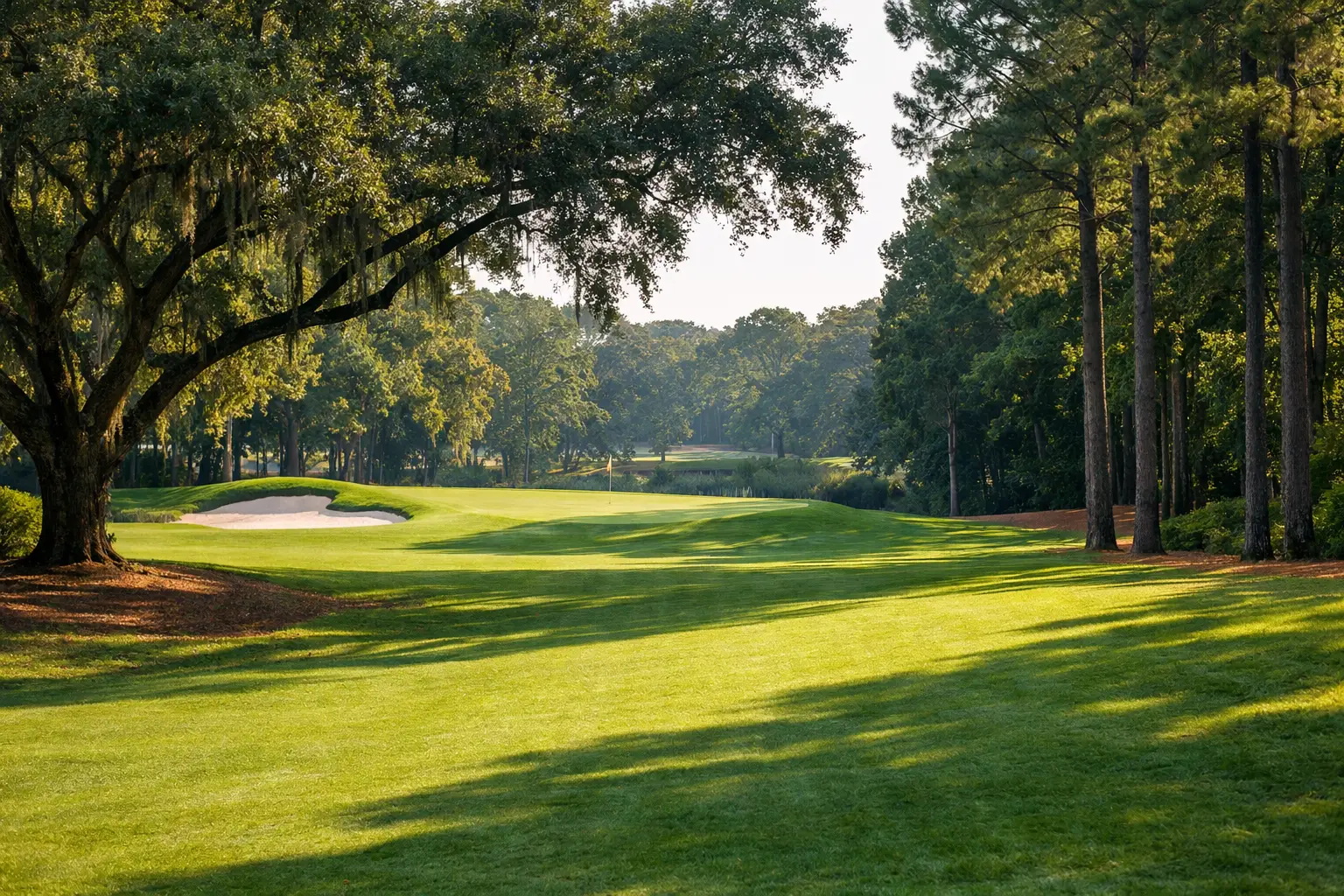
A fairway can look acceptable from the tee while quietly consuming an excessive share of labour, water, fertiliser and chemical inputs. The issue is often not a poor maintenance programme. It is insufficient light, restricted air movement and prolonged leaf wetness. Fairway shade management is therefore not simply a tree-pruning discussion. It is an operating decision that affects turf quality, golfer experience, environmental risk and the annual maintenance budget.
For boards and managers, the key question is not whether mature trees have value. They clearly do. The question is whether each tree, or group of trees, is compatible with the turf surface and playing conditions the club has committed to provide.
Why fairway shade management demands board attention
Turf needs adequate sunlight to produce energy, recover from traffic and maintain root mass. When light is reduced, the plant becomes less resilient. It produces thinner leaf cover, weaker roots and less carbohydrate reserve. Add morning dew that cannot dry, poor air movement and cart traffic through the same low-light zone, and a manageable weak patch becomes an ongoing failure point.
On Australian courses, the symptoms vary by location and grass species. Couch fairways may thin rapidly where winter shade compounds low temperatures. Kikuyu can be vigorous in full sun but struggle to hold a consistent, tight surface under dense canopies. In cooler regions, shaded areas may remain wet longer into the day, increasing disease pressure and limiting the window for mowing or spraying.
The commercial impact is usually gradual rather than dramatic. Staff add hand watering, spot fertiliser, extra fungicide, seed, sand and labour. They may reduce mowing height in an attempt to improve presentation, only to place further stress on already compromised turf. Members see bare ground, mud, uneven lies and temporary ground under repair. The club pays twice: once in direct inputs and again in reduced confidence in course presentation.
Start with evidence, not assumptions
A tree line that looks attractive at midday can cast its most damaging shadow between 8 am and 11 am, when turf needs light and leaf surfaces need to dry. One inspection is not enough. A proper assessment should record shade across seasons, particularly in winter when the sun angle is lowest and recovery potential is limited.
The first step is to map recurring weak areas. Review where turf consistently thins, where disease appears first, where irrigation run times have crept upward and where staff repeatedly carry out repairs. Compare these areas with canopy extent, tree height, aspect, surface drainage and prevailing wind.
This matters because shade is rarely acting alone. A fairway may be shaded, compacted and poorly drained at the same time. Removing a branch might improve light but will not correct a blocked drain or a poorly performing irrigation head. Conversely, an irrigation adjustment may reduce leaf wetness but cannot compensate for a fairway receiving only a fraction of the light required for healthy growth.
Good assessment combines site observation with records. Irrigation data, soil moisture readings, disease logs, mowing records and photographs taken from consistent points provide useful evidence. Where the issue is significant, measuring daily light levels before and after works gives the board a defensible basis for investment.
Identify the real constraint
There are three main constraints to separate: direct shade, reduced air movement and root competition. Dense canopies reduce usable sunlight. Trees and screens can also trap humid air, keeping the turf wet and raising disease risk. Below ground, established trees may draw heavily on moisture and nutrients, leaving the fairway stressed even when the surrounding profile appears adequately irrigated.
Treating all three as a single “shade problem” leads to weak decisions. The management response needs to match the dominant constraint.
Choose the intervention that fits the site
The objective is not to clear every tree around a fairway. It is to create enough sunlight and airflow for turf to perform consistently while retaining the course character, strategic design, habitat value and visual appeal that matter to members.
Selective canopy lifting or thinning is often the first practical option. Removing lower limbs and carefully reducing density can admit early sunlight and improve airflow without changing the visual identity of the hole. This work must be completed by qualified arborists and guided by a clear turf outcome, not by arbitrary percentage reductions.
Where a tree is directly responsible for chronic turf decline, full removal may be justified. That decision requires more scrutiny. Significant trees can carry heritage, environmental and member-value considerations, and local council approvals may apply. A removal programme should include replacement planting in locations that will not recreate the same problem in ten or fifteen years.
Root pruning, physical barriers and irrigation changes can help in limited circumstances, but they are not universal fixes. Root pruning may affect tree stability and health. Barriers can be costly and disruptive. Increasing irrigation to compensate for tree competition can worsen softness, disease and water use if light is still inadequate. These options need technical oversight rather than a trial-and-error approach.
In some locations, changing the turf species or managing a defined low-light area differently may be the most financially sensible choice. That is a legitimate decision if the club accepts the playing and presentation standard that follows. It should not be used as a way to avoid addressing an obvious canopy conflict on a key fairway landing area.
Time works around turf recovery and member use
Tree work is most valuable when the turf has a realistic opportunity to respond. In warm-season fairways, opening a canopy before the active growing period allows couch or kikuyu to recover through the warmer months. Waiting until late autumn can leave the surface exposed but unable to fill in before winter.
The programme also needs to account for playing calendars, bird nesting considerations, contractor access and the risk of storm damage. Major works should be staged. Start with the highest-cost, highest-visibility failure points, then measure the result before extending the programme across the course.
Post-work management is just as important. A newly opened area may need adjusted irrigation because evapotranspiration will increase. It may require targeted nutrition, compaction relief, overseeding where appropriate and sensible traffic control while cover returns. Pruning alone is not a turf recovery plan.
Set measurable outcomes and clear accountability
Fairway shade management should sit within the annual maintenance plan, with a nominated owner, budget and reporting cycle. Vague instructions such as “open up the trees around the fifth” invite inconsistent results. Define the turf areas affected, the canopy works approved, the recovery actions required and the measures that will determine success.
Useful measures include turf cover percentage, hours of direct morning sunlight, soil moisture consistency, disease incidence, chemical applications, repair labour and golfer complaints. Not every result will improve immediately. A previously shaded area can take a full growing season to rebuild roots and density. However, the direction of travel should be visible, and maintenance inputs should become more controlled rather than escalating each year.
This is where independent oversight adds value. The person recommending work should be accountable for the turf outcome and able to explain the financial logic to management and the board. Gen1 Sportsturf approaches these issues as a whole-of-course performance decision, linking tree management, irrigation, agronomy, staffing and reporting rather than treating each poor patch as an isolated maintenance problem.
Avoid the common cost traps
The most expensive approach is usually repeated patch repair without correcting the cause. Resodding a shaded, wet fairway section may improve appearance for a short period, but the same conditions will thin the new turf. Repeated fungicide use can suppress symptoms while leaving the environmental conditions untouched. Overwatering to keep a weak plant green creates another set of risks.
The opposite mistake is aggressive clearance without a site plan. Removing trees too broadly can create heat stress, expose players to wind, alter course strategy and trigger justified member concern. It can also leave an awkward visual outcome that takes decades to soften.
A disciplined programme makes targeted decisions, communicates the reason for them and reports the results. Members are more likely to support necessary change when they can see that the purpose is firmer, healthier fairways and better year-round playability, not tree removal for its own sake.
The right outcome is not a course with fewer trees. It is a course where trees, turf and playability are planned to work together - and where recurring weak areas no longer dictate the maintenance budget.