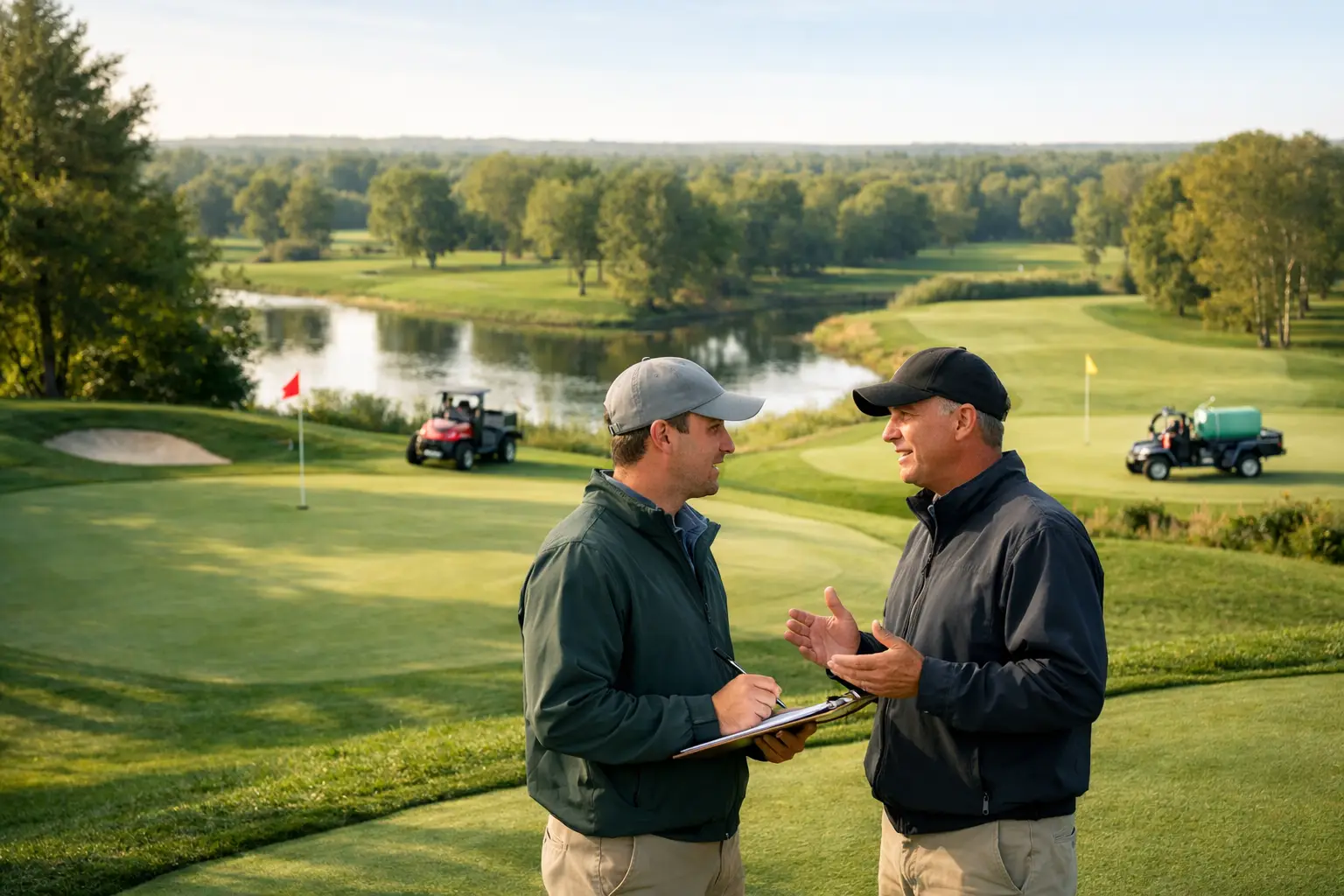
A superintendent vacancy can put a club under immediate pressure. Turf does not pause while a board recruits, budgets are reviewed or a committee decides what the role should look like. So, can clubs share superintendents? Yes, but only when the arrangement is built around clear authority, realistic site capacity and disciplined accountability. A poorly structured shared role simply spreads one person too thin. A well-structured model gives multiple facilities access to senior turf leadership they could not independently afford.
For many golf clubs, bowling clubs, councils and sports venues, the more useful question is not whether to share a person. It is which superintendent responsibilities need senior direction, which tasks must remain on site, and how performance will be measured.
Can clubs share superintendents without lowering standards?
They can, provided the shared superintendent is not expected to be everywhere at once. Turf quality is won through daily execution: irrigation checks, presentation, mowing, machinery care, staff supervision and rapid responses to weather, disease or irrigation failures. Those activities need capable people on the ground.
The superintendent function, however, includes a broader layer of work that can often be shared or delivered fractionally. This includes agronomic planning, maintenance programming, irrigation analysis, chemical compliance oversight, budget control, contractor management, staff mentoring and reporting to the board or general manager.
That distinction matters. A senior turf leader can set standards, identify risk and direct resources across more than one site. They cannot replace the daily presence of an appropriately skilled leading hand, course manager or greenkeeping team at every facility.
The model is strongest where each club has stable operational staff but lacks senior technical leadership. It is much weaker where a club has no reliable on-ground crew, failing equipment, neglected irrigation and a belief that one visiting superintendent will somehow solve every operational issue.
Three ways a shared superintendent model can work
There is no single structure that suits every club. The right model depends on distance between sites, the complexity of each facility, staff capability and the level of member expectation.
One employed superintendent across aligned clubs
Two nearby clubs may jointly employ one superintendent and share the salary, vehicle, equipment allowance and employment costs under a formal agreement. This can work where both sites are modest in scale, have compatible standards and are close enough to allow regular site attendance.
The risk is governance. If two boards give competing instructions, the superintendent becomes accountable to no one and pulled in two directions. Before appointing anyone, the clubs need to agree on reporting lines, priority-setting, cost allocation, leave cover, emergency response and who makes the final call when requirements clash.
This approach is generally best for closely located facilities with similar operating models. It becomes difficult when one club is private and presentation-led while the other is a resource-constrained public facility with fundamentally different service expectations.
A lead club provides support to another facility
In some cases, a larger club employs a capable superintendent who provides scheduled support to a nearby venue. The second club gains technical input, while the lead club receives a contribution towards its senior employment cost.
This arrangement should never compromise the lead club's obligations. Tournament preparation, seasonal renovation, storm damage, staff leave and major projects can quickly consume a superintendent's available time. The supporting role should be limited, scheduled and documented, rather than treated as an informal favour that expands whenever problems arise.
Fractional superintendent or independent consultant
A fractional model gives a club access to senior leadership for an agreed number of site days, remote review and planned reporting without taking on a full-time executive salary. The consultant establishes the operating plan, audits turf and irrigation performance, reviews inputs and budgets, mentors the team, and provides independent advice to management and the board.
This is not a replacement for greenkeepers. It is a leadership and accountability structure for getting more from the people and resources already on site. Gen1 Sportsturf applies this model with a clear division of responsibility: the facility team executes the work, while senior turf direction sets the programme, reviews results and addresses risks before they become costly failures.
The commercial case needs to be honest
Sharing senior expertise can make sound commercial sense. A full-time superintendent carries more than a salary. Clubs must account for superannuation, leave, recruitment risk, professional development, vehicle costs and the operational impact when the role is vacant.
But cost sharing is not automatically a saving. If a shared arrangement leads to excessive contractor use, poor irrigation decisions, delayed disease response or staff turnover, the apparent saving can disappear quickly. The objective is not to buy the cheapest possible supervision. It is to secure the right level of leadership for the facility's risk profile and budget.
Boards should assess the model against measurable outcomes: water use, chemical records, labour allocation, machinery downtime, turf recovery after renovation, member complaints, playing-surface consistency and budget variance. These indicators turn the discussion from personalities and preferences into operational performance.
A shared superintendent model also needs a defined scope. If the agreement only says “provide turf advice as required”, it will fail. The club should know how often the superintendent attends, what is reviewed, who receives reports, how urgent issues are handled and what decisions remain with management.
Authority is the point that usually breaks down
The greatest threat to a shared arrangement is unclear authority. A superintendent can recommend a fertiliser programme, water-management plan or renovation schedule, but someone at the club must have authority to ensure the work is completed and funded.
Each facility should nominate one accountable contact, usually the general manager, operations manager or a delegated committee representative. That person should be responsible for approving priorities, receiving reports and preventing instructions from being issued through multiple channels.
The on-ground team also needs clarity. Staff should know who sets daily work priorities, who approves purchases, who signs off chemical applications and who responds when irrigation fails on a Saturday morning. Ambiguity wastes labour and weakens standards.
Where clubs jointly employ a superintendent, a written service-level agreement is essential. It should cover at least attendance expectations, cost sharing, use of vehicles and equipment, intellectual property and records, confidentiality, dispute resolution, insurance, work health and safety responsibilities, and termination arrangements. Obtain appropriate employment and legal advice before finalising the structure.
What must stay on site
Even the best shared model has limits. The following functions require reliable local ownership: daily course or surface setup, routine irrigation observation, staff attendance and safety, chemical storage security, machinery checks, member-facing issues and immediate weather responses.
A consultant or shared superintendent can build systems for these tasks, train the team and audit compliance. They should not become the remote substitute for a missing crew. If the existing team is inexperienced, the club may first need to appoint a capable supervisor or invest in practical mentoring before reducing senior on-site coverage.
The same applies to major capital issues. A failing pump station, poor drainage, obsolete irrigation control system or undersized machinery fleet cannot be solved by better reporting alone. Senior oversight will identify the issue and create a prioritised plan, but the board must still make investment decisions.
A disciplined way to test the option
Before entering a shared arrangement, conduct a proper operational review. Start with turf condition, irrigation capacity, water consumption, staffing levels, machinery reliability, chemical systems, budgets and the annual maintenance calendar. Then assess the gap between current capability and the standard the club expects to deliver.
From there, define the required senior inputs. One venue may need monthly strategic visits and seasonal planning. Another may need weekly support during a recovery period, followed by a reduced retainer once systems and staff capability improve. A fixed arrangement that ignores seasonal demand is rarely efficient.
Finally, establish a reporting rhythm. A concise monthly report should identify completed actions, current turf risks, water and chemical issues, labour pressures, budget position and decisions required from management or the board. This is how a shared superintendent model remains accountable rather than becoming invisible between site visits.
The right arrangement does not ask whether one person can do the work of two or three. It asks whether each club has the people, systems and authority to execute a clear plan. When those foundations are in place, shared senior leadership can protect turf quality and capital while giving boards a far more defensible operating position.