A green can look clean, firm and fast while its rootzone is quietly losing the capacity to support it. Water may sit on the surface after irrigation, roots may shorten, and disease pressure may rise just as member expectations peak. This green aeration guide is designed for clubs and facilities that need to treat aeration as a planned performance programme, not a disruptive maintenance event.
For boards and managers, the question is not whether aeration inconveniences play. It is whether the cost of short-term disruption is lower than the cost of poor surfaces, reactive chemical use, excessive water demand and eventual reconstruction. In almost every case, it is.
Why green aeration is a business-critical practice
Golf greens operate under sustained pressure. Mowing heights are low, traffic is concentrated, organic matter accumulates near the surface, and irrigation decisions often need to respond to heat, wind and event schedules. Over time, the rootzone can become compacted and layered. Air exchange slows, infiltration declines and roots are forced into a shallower, less resilient profile.
Aeration manages that risk. It creates channels for oxygen, water and roots, relieves compaction, dilutes or removes organic material, and helps maintain the firm, predictable surfaces players value. Done properly, it also provides a clearer picture of what is happening below ground rather than relying on surface appearance alone.
The commercial case is equally clear. A weak rootzone increases labour, water, fertiliser and chemical inputs. It produces inconsistent greens that generate member complaints and place pressure on the maintenance team. A disciplined aeration programme protects the asset, supports better resource control and gives management a defensible plan for balancing playing quality against long-term turf health.
Green aeration guide: start with diagnosis, not machinery
Selecting a method because it is familiar, or because it was used last year, is not a strategy. The correct aeration approach depends on the condition of the profile, grass species, soil type, climate, drainage performance and recovery window.
A proper diagnosis starts with soil cores. Review organic matter depth, layering, root depth, moisture distribution and signs of black layer or anaerobic conditions. Probe multiple locations, not just the worst green. A representative assessment should include shaded areas, high-traffic entry points, low spots and greens with different construction histories.
In Queensland, heat, humidity and high biological activity can drive rapid organic matter accumulation and disease risk. In New South Wales and Victoria, cool-season growth patterns, winter recovery limitations and wet-season compaction may alter the timing and intensity required. A coastal sand profile will behave very differently from an older push-up green or a profile with fine-textured material restricting drainage.
Data should determine the programme. That includes infiltration observations, moisture readings, clipping yields, irrigation run times, disease records and member feedback. These indicators do not replace physical inspection, but together they prevent costly assumptions.
Match the method to the problem
There is no single aeration treatment that solves every issue. The method must align with the objective.
Solid-tine aeration is useful for creating channels with limited surface disruption. It can relieve mild compaction and promote gas exchange, making it suitable for in-season work when recovery time is tight. However, it does not remove organic matter. If thatch and surface layering are the underlying issue, repeated solid tining alone can compact material around the channels and delay the real solution.
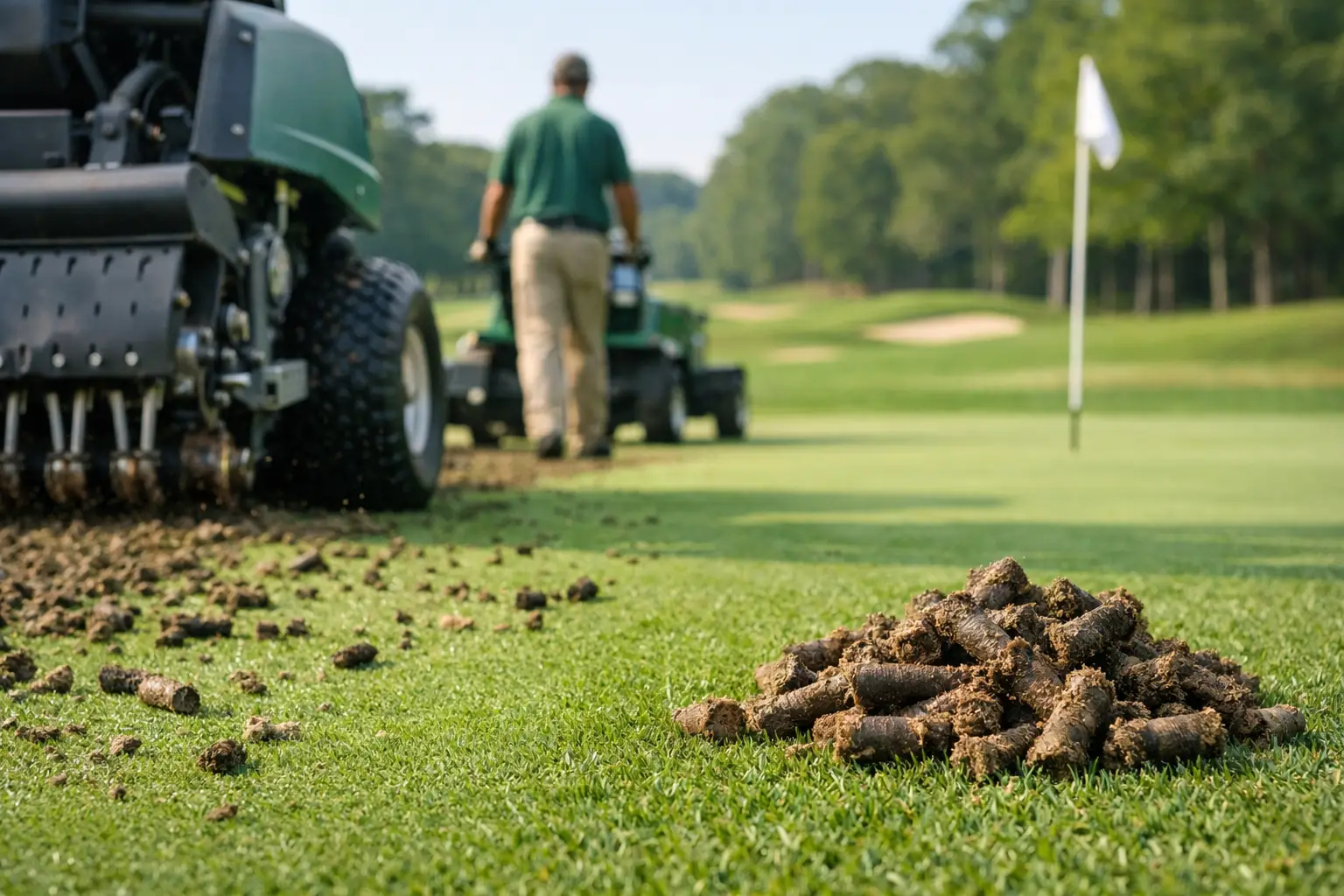
Hollow coring removes plugs of organic material and soil, creating space for clean sand to be incorporated. It is one of the most effective tools for managing excessive organic matter and restoring physical balance in the upper profile. The trade-off is disruption. Hole size, spacing, cleanup standard and recovery conditions all affect how quickly greens return to presentation standard.
Deep-tine aeration targets compaction lower in the rootzone and can improve drainage pathways where shallow treatments have limited effect. It must be used carefully. On unstable profiles, aggressive heaving can damage surface smoothness or disturb layering in ways that create new problems. Equipment settings and soil moisture need close control.
Needle tining and pencil tining provide frequent, low-disruption oxygen exchange. They are valuable between major renovations, particularly during periods of high play, but should support rather than replace a broader organic matter management plan. Water injection, air injection and sand injection systems can also have a place, but they should be assessed against measurable need, not purchased or hired because they appear less disruptive.
Timing is about recovery, not the calendar
The best treatment applied at the wrong time can produce a poor result. Recovery depends on active growth, temperature, moisture management, light, nutrition and traffic. Clubs should build their aeration calendar around these conditions first, then work through competition and event commitments.
For warm-season turf, major hollow coring is generally best planned when active growth will support reliable recovery. For cool-season bentgrass and Poa annua surfaces, autumn and spring windows may be more suitable, provided weather and disease risk are considered. There are exceptions. A green with severe surface sealing or poor infiltration may need intervention outside the preferred window because doing nothing carries greater risk.
This is where governance matters. The course manager or greenkeeping team should present the operational case early, including the condition evidence, proposed method, expected recovery period and consequences of deferral. Boards should not be asked to approve a vague renovation programme. They need a clear decision supported by turf data, playing impact and budget implications.
Member communication also needs discipline. Avoid describing aeration as a simple inconvenience or promising unrealistically quick recovery. Explain the purpose in practical terms: firmer surfaces, healthier roots, more consistent pace and reduced risk of decline during demanding weather. Members are more accepting when the work is scheduled, well executed and visibly tied to better conditions.
Sand is part of the system
Aeration without an appropriate topdressing programme leaves much of the value on the table. Sand is used to dilute organic matter, maintain surface levels, improve firmness and preserve pore space in the upper rootzone. The particle size, shape and compatibility of the sand matter. An unsuitable material can create layers, reduce infiltration or compromise putting quality.
Light and frequent topdressing is often less disruptive than relying only on heavy applications after coring. It helps manage organic accumulation before it becomes an urgent problem and supports smoothness throughout the season. The right rate will depend on growth, clipping removal, hollow-coring volume and the existing condition of the profile.
The operational challenge is integration. Sand must be applied at a rate the team can properly brush, drag or wash into the canopy without smothering turf or leaving inconsistent coverage. Irrigation needs to support incorporation without causing runoff or over-wetting the profile. These are not separate tasks. They are one rootzone management system.
Recovery plans protect the investment
The work after aeration determines whether the programme delivers its intended value. Recovery planning should cover mowing, rolling, moisture management, nutrition, disease monitoring, sand incorporation and traffic control. It should also nominate who is responsible for checking results and reporting exceptions.
Do not over-water freshly aerated greens simply because the surface looks open. Excess moisture can slow oxygen exchange, soften the surface and increase disease risk. Use moisture data and field observation to manage the rootzone, not a fixed irrigation routine. Similarly, nutrient inputs should support recovery without forcing soft, weak growth that compromises firmness.
Daily records during recovery are worthwhile, especially after major coring. Track surface appearance, ball roll, moisture, disease activity and root response. If a green lags behind the rest, investigate the cause. Shade, irrigation coverage, drainage, traffic and underlying construction may all be contributing factors. Treating every green identically is efficient only on paper.
Measure outcomes and adjust the programme
Aeration should be reviewed as a performance programme, not signed off when the holes disappear. Compare pre- and post-treatment information: infiltration, firmness, root depth, moisture consistency, disease incidence, surface smoothness and irrigation demand. Review labour hours, sand use and lost-playing-time implications as well.
A strong annual plan will identify major renovation windows, lower-disruption in-season treatments, topdressing targets and trigger points for intervention. It should also be flexible enough to respond to weather and turf condition. A delayed programme can be sensible after an adverse weather event; repeatedly deferring it for fixture pressure is not.
Independent oversight can be valuable where a club has a leadership gap, an inexperienced team or persistent concerns around green performance. Gen1 Sportsturf approaches aeration as part of the wider maintenance system, linking rootzone condition to irrigation, nutrition, chemical compliance, labour allocation and board reporting.
The best aeration programme is rarely the most aggressive one. It is the one that matches the profile, is executed at the right time, funded properly and measured honestly. Get those decisions right, and the next busy season begins with healthier greens and fewer explanations to make.