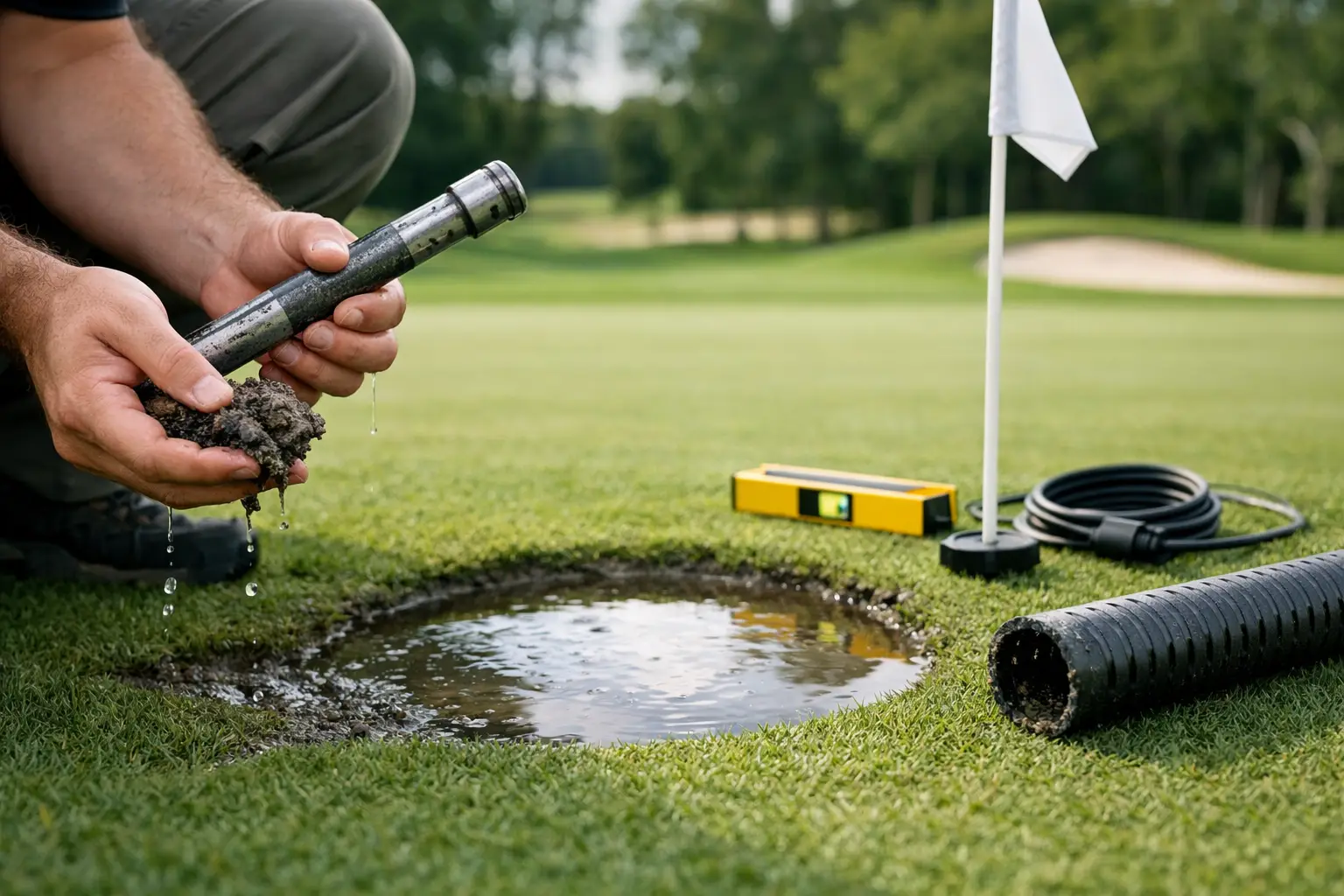
A green can look acceptable on a dry Monday and still carry a drainage problem that will cost the club dearly through the next wet spell. To assess putting green drainage properly, the focus must be on what happens below the surface, how quickly the green recovers after rainfall, and whether water is moving through the profile as designed. Surface puddles are only one part of the diagnosis.
For boards, general managers and course teams, drainage should be treated as a performance, asset-protection and capital-planning issue. Poor drainage reduces available playing days, weakens turf, increases disease pressure and encourages expensive reactive maintenance. A disciplined assessment identifies the cause before money is committed to sand, drains or reconstruction.
Drainage failure is rarely just a drainage issue
Water sitting on a green may point to blocked outlet lines or inadequate falls. It can also be caused by surface sealing, accumulated organic matter, compacted rootzone, incompatible sand layers, poor irrigation scheduling or a perched water table. Treating every wet green with more aeration or topdressing is not a strategy. It may help temporarily, but it will not correct a structural failure.
The consequence is usually a cycle of soft surfaces, restricted mowing, reduced green speed and inconsistent ball roll. In high-rainfall parts of Queensland and coastal New South Wales, prolonged leaf wetness also raises disease risk and chemical inputs. In Victoria and cooler southern regions, winter wetness can restrict recovery and expose weak areas to traffic damage.
The operational question is not whether a green holds water after a significant storm. Even well-built greens have a recovery period. The question is whether recovery is consistent with the green's construction, soil profile, rainfall event and expected standard of play.
Start by assessing putting green drainage after rain
The most useful inspection occurs after a meaningful rainfall event, not on a dry day when problems are easy to miss. Record the rainfall total, duration and intensity, then inspect the green at set intervals: immediately after rain, several hours later and the following morning. Repeat this across more than one event where possible.
Map ponding areas, soft zones, water tracking across the surface and any location where water enters from surrounds or bunkers. Note whether the same areas remain wet every time. A recurring pattern usually indicates a physical or design issue, while random wetness may relate more closely to irrigation coverage, isolated compaction or maintenance activity.
Pay attention to the relationship between the green and its surrounds. A well-drained putting surface can still fail if runoff from mounds, paths, bunkers or adjacent fairway grades is directed onto it. Water should be managed before it reaches the green, not merely dealt with once it is in the rootzone.
Staff observations are valuable, but they need to be recorded consistently. A simple map showing affected areas, rainfall, recovery time and the maintenance response creates evidence that can be used for operational decisions and board reporting.
Check the surface before assuming the drains have failed
Surface infiltration can be tested with ring infiltrometers or other practical field methods. The purpose is to compare water entry rates across dry, firm and problem areas. Low infiltration in a localised patch may point to sealing, compaction or excessive organic matter. Broadly poor infiltration across the green suggests a profile-wide issue.
Organic matter testing is particularly important on mature greens. Thatch and organic accumulation can create a dense layer near the surface that holds water above the rootzone. The green may feel soft and wet while the drainage network below remains functional. In that scenario, targeted hollow coring, sand topdressing and a revised organic matter programme may deliver a better return than installing new drainage.
Irrigation must also be taken out of the equation. Check for leaking valves, excessive runtimes, uneven distribution and irrigation heads throwing water onto low points. A drainage diagnosis made without reviewing water application is incomplete.
Inspect the rootzone profile and construction layers
A profile sample tells the story that surface observation cannot. Take cores from affected and unaffected areas, then compare root depth, moisture, sand texture, organic matter, layering and compaction. If possible, inspect the profile to the gravel blanket or drainage layer.
Look for fine material migrating into coarse sand, distinct layers that interrupt water movement, black or grey anaerobic zones, and roots concentrated in a shallow band. Sulphurous odours and dark, reduced soils indicate prolonged saturation and oxygen shortage. These conditions limit root growth even where the surface appears reasonably firm.
Greens constructed to USGA-style specifications should generally move water freely through a sand-based rootzone to the gravel layer and lateral drainage. Older push-up greens, modified soil greens and greens rebuilt in stages behave differently. Their drainage capacity depends heavily on native soil characteristics, compaction, surface contour and the condition of any installed pipework.
This distinction matters commercially. A deep-tine programme may be appropriate for a compacted push-up green, but it will not repair a blocked collector line. Conversely, an extensive pipe-drainage project may be unnecessary if the actual issue is a 25-millimetre organic layer near the surface.
Test drainage lines, outlets and discharge points
Where drainage infrastructure exists, trace it from the green to the outlet. Inspect pits, silt traps, collector lines and discharge points for sediment, root intrusion, crushed pipe, poor falls or standing water. Camera inspections and flushing can be justified where recurring problems affect high-value greens or where reconstruction decisions are being considered.
An outlet that is submerged, blocked or set too high cannot drain the system effectively. This is often missed because the problem is not visible on the putting surface. Drainage lines also need a viable point of discharge. Moving water into a blocked swale or saturated low area simply relocates the issue.
A competent assessment also checks whether old plans match what is in the ground. Many clubs have incomplete construction records, and decades of renovations can leave a mix of drain materials, depths and layouts. Assumptions are expensive when capital works are involved.
Separate urgent actions from capital works
Once the cause is clear, responses should be prioritised by risk, cost and expected outcome. Immediate actions may include clearing outlets, repairing irrigation leaks, redirecting runoff, adjusting mowing and restricting traffic on saturated areas. These measures protect turf while the broader programme is developed.
Medium-term work may involve hollow coring, deep-tine aeration, sand injection, consistent light topdressing or reshaping small surface depressions. Each practice has a place, but timing matters. Aggressive cultivation during heat, disease pressure or weak recovery can create more damage than benefit.
Capital works should be reserved for confirmed structural problems: failed drainage lines, inadequate discharge, unsuitable rootzone construction, severely compromised contours or greens that no longer meet the club's playability standard. Options range from targeted interception drainage and surface regrading to full reconstruction. The right choice depends on the life remaining in the green, the severity of the fault, member expectations and the club's capital position.
Do not assess projects on installation cost alone. Include lost playing time, repeated reactive labour, additional fungicide use, sand consumption, equipment wear and reputational damage from unreliable greens. A lower-cost patch repair can be sensible. It can also become false economy if the same green is closed or heavily managed after every major rain event.
Build drainage into the maintenance plan
Drainage performance should be measured, not discussed only when a green becomes unplayable. Set acceptable recovery benchmarks after defined rainfall events, track infiltration and organic matter trends, and maintain records of aeration, topdressing and drain maintenance. This gives the course manager a defensible basis for programme changes and gives the board a clear view of asset risk.
The maintenance programme must match the green's construction and usage. High-traffic club greens may need more frequent light sand applications to maintain surface porosity. Greens with persistent organic layering may need a deliberate dilution and cultivation plan over several seasons. Older soil-based greens may require greater focus on surface drainage, firmness and controlled water inputs.
Independent assessment is particularly valuable where a club is receiving competing advice from contractors or product suppliers. The objective should be a documented diagnosis, a ranked action plan and clear success measures - not a pre-selected product or drainage solution.
A putting green does not need to be dry to perform well. It needs air-filled pore space, healthy roots, stable moisture and a predictable recovery after rain. When those conditions are monitored with discipline, drainage investment becomes a controlled decision rather than an emergency response.