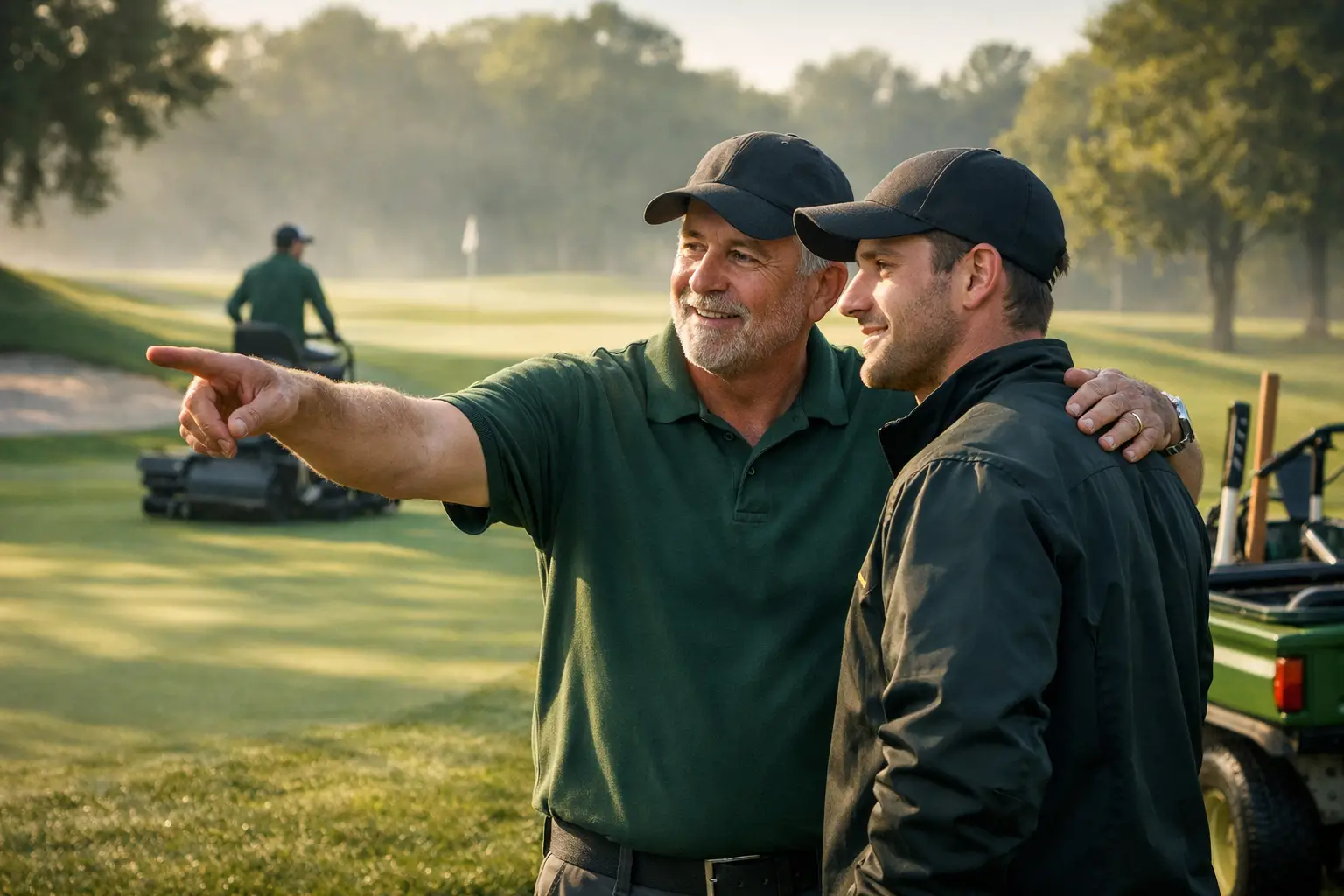
A course can have a sound maintenance budget, capable hands on the tools and good equipment, yet still lose ground when day-to-day decisions are made without clear technical leadership. Greenkeeping staff mentoring addresses that gap. It gives the existing crew practical direction, builds judgement at every level and creates a standard that does not disappear when one experienced person is away.
For boards, committees and general managers, this is not a soft staff-development exercise. It is an operational control. Better mentoring reduces costly rework, strengthens chemical and irrigation discipline, improves presentation consistency and gives facilities a more credible succession path in a tight labour market.
Why capable crews still need senior direction
Most greenkeeping teams are not short of effort. They are short of time, technical context or access to someone who has seen the same problem unfold across different soil profiles, climates and facility types. A second-year apprentice may know the morning job list but not understand why mowing frequency changes after a humid week. A leading hand may recognise dry turf but lack the confidence to separate irrigation coverage issues from compaction, hydrophobicity or disease pressure.
Without mentoring, crews often fall back on routine. Routine has value, but it can also hide declining turf health, inefficient water use and poor prioritisation. The consequence is usually visible well before it reaches the board report: inconsistent surfaces, reactive chemical applications, worn presentation areas and overtime spent correcting issues that should have been prevented.
Senior guidance changes the decision-making process. Staff learn what to inspect, what to record, when to escalate and which actions carry the greatest risk. That is how a maintenance team moves from completing tasks to managing a playing surface.
What effective greenkeeping staff mentoring looks like
Good mentoring is not a monthly lecture delivered from an office. It happens in the shed, on the irrigation controller, beside a stressed green and during a review of the weekly work programme. It is specific, repeatable and tied to the facility's standards.
The strongest approach combines field coaching with structured accountability. The team needs to understand the reason behind the programme, but it also needs clear ownership of execution. If a green is showing wilt, the discussion should cover root depth, moisture readings, distribution uniformity, weather forecasts and traffic patterns - not simply whether another irrigation cycle should be run.
Mentoring should also suit the capability of the individual. An apprentice needs clear demonstrations and supervised repetition. A senior greenkeeper may need more exposure to planning, budgeting, staff allocation and reporting. A course manager or grounds supervisor may need support to make defensible recommendations to management. Treating every staff member the same slows development and leaves leadership potential unused.
Coaching the work that affects turf quality
The highest-value coaching centres on decisions with a direct effect on surface performance and operating cost. This includes irrigation scheduling, moisture management, fertiliser timing, chemical selection and application records, mowing quality, disease identification, aeration planning and machinery set-up.
These areas are interdependent. Poor mower set-up can damage presentation and plant health. Excess water can weaken turf, raise disease pressure and increase pumping costs. A rushed chemical decision can create compliance exposure as well as an unsatisfactory playing surface. Staff need to see these connections, because the best decision is rarely the fastest or most familiar one.
A mentor should establish practical inspection habits. Morning observations need to be consistent. Moisture data should inform irrigation decisions rather than sit unused. Chemical records should be complete before they are needed for an audit. Work plans should reflect weather, events and available labour, not simply repeat last week's schedule.
Turning standards into daily behaviours
Facilities often say they want championship-level conditions, but standards only matter when they can be translated into daily behaviours. What is the acceptable finish after mowing? Which areas receive priority before a major event? How are irrigation faults reported and followed through? What does a completed bunker edge, rink surround or sports field line actually look like?
Written operating standards are useful, provided they are practical. The crew should be able to apply them without guessing. Photos, checklists and short site-based demonstrations can help, but the real test is whether supervisors inspect completed work and give timely feedback.
Accountability must be fair. If a team member has not been shown the expected method, poor results are a leadership failure before they are a staff failure. Once the standard has been trained, resourced and checked, the expectation can be firm.
Build mentoring into the maintenance system
Mentoring works best when it is part of a defined operating rhythm rather than an occasional response to a problem. A facility does not need a large management layer to create that rhythm, but it does need someone responsible for setting priorities and reviewing outcomes.
A practical monthly structure may include a site inspection with the crew leader, review of irrigation and weather data, chemical compliance checks, assessment of current turf risks and a forward work plan. The mentoring component should identify one or two skills to develop that month, assign responsibility and revisit progress at the next review.
For example, a club facing rising water costs may focus first on irrigation capability. The staff member responsible for watering can be coached to use moisture data, inspect heads and nozzles, identify coverage weaknesses and document changes to the schedule. The outcome is not merely a better-trained employee. It is more informed water use, earlier fault detection and a clearer explanation of costs to the board.
A council sports venue may instead need to develop event recovery planning. Coaching could focus on assessing wear, allocating labour after high-use weekends, selecting appropriate renovation actions and communicating realistic recovery timeframes. The right priority depends on the asset, season, staffing level and current risk.
The commercial case for mentoring
Recruiting a proven superintendent or senior turf manager is difficult and expensive. For many clubs and public facilities, a full-time appointment is not financially realistic. Leaving a less experienced team without senior direction, however, creates a different cost - declining conditions, staff turnover, unnecessary inputs and governance risk.
Greenkeeping staff mentoring provides a middle path. It allows an existing team to remain responsible for execution while accessing experienced strategic oversight. That structure protects the budget while raising the quality of decisions being made on site.
The financial benefits are often found in avoided waste rather than dramatic cuts. Better irrigation management can reduce water and energy use. Planned nutrition and chemical programmes can reduce reactive spending. Improved machinery practices can limit premature wear and quality failures. Clear work allocation can reduce overtime and rework. Just as importantly, documented processes provide boards with evidence that maintenance risks are being actively managed.
This is why independent advice matters. A mentoring programme should not be shaped by a need to sell products or justify unnecessary capital expenditure. Recommendations should be based on site conditions, data, risk and the facility's realistic operating capacity.
Where mentoring programmes commonly fail
The first failure is relying on generic training. A course in chemical handling or irrigation basics has value, but it does not replace coaching on the facility's own soils, water source, equipment and playing expectations. Staff need both formal qualifications and site-specific judgement.
The second is giving advice without follow-up. A recommendation that is not assigned, checked and adjusted becomes another item in a notebook. Mentoring needs a record of actions, deadlines and outcomes.
The third is confusing micromanagement with leadership. Senior oversight should clarify priorities and build capability, not remove all initiative from the crew. The objective is a team that can make better decisions independently within agreed boundaries.
Finally, mentoring fails when boards expect immediate cosmetic change but do not support the operational disciplines behind it. Turf recovery takes time. Water restrictions, weather, budgets and labour availability all affect the result. Good leadership sets ambitious standards while being honest about the trade-offs required to achieve them.
A stronger team is a more resilient facility
The best time to invest in staff capability is before a superintendent leaves, a key employee burns out or turf quality reaches a point where recovery becomes expensive. Mentoring gives facilities continuity. It protects knowledge, develops emerging leaders and reduces dependence on one person holding every answer.
Gen1 Sportsturf applies this discipline through practical site leadership, independent technical advice and clear reporting that staff and boards can act on. The aim is not to take work away from the crew. It is to give them the direction, confidence and accountability required to deliver better outcomes.
A well-mentored greenkeeping team will still face difficult weather, budget pressure and demanding members. The difference is that it will meet those pressures with a plan, credible data and a clearer understanding of what good work looks like.