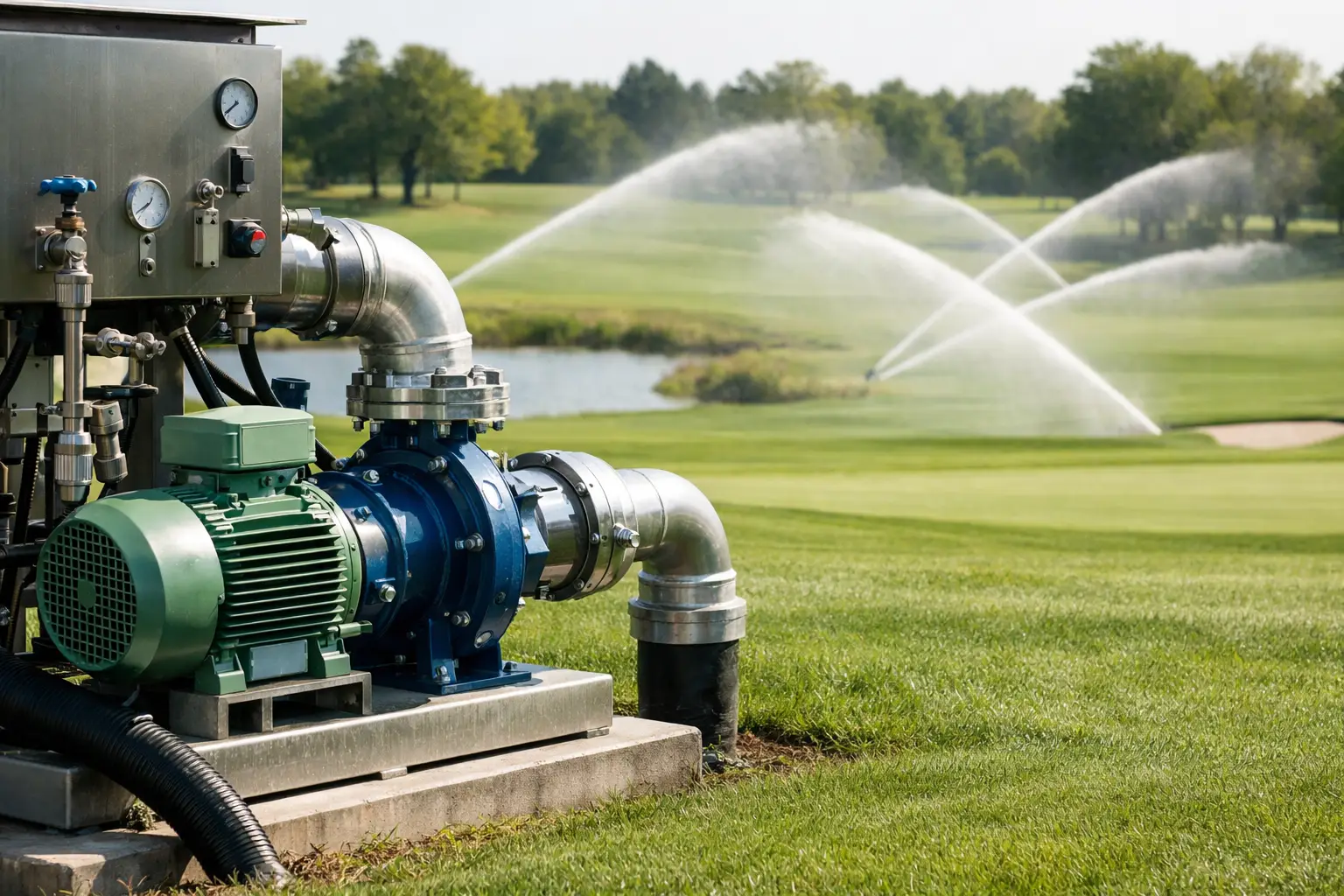
A pump running for extra hours is rarely just an electricity issue. At a golf club, bowling club or council sports ground, poor irrigation pump efficiency can lead to uneven coverage, stressed turf, higher water bills, emergency repairs and staff time spent compensating for a system that is not performing as designed. The cost is felt across the operation, not simply on the power account.
The practical objective is not to chase the lowest possible pump run time. It is to deliver the required flow and pressure, to the right areas, at the lowest sensible energy and maintenance cost, without compromising playing surfaces. That requires a measured approach. Turning down a pump or changing a schedule without understanding the hydraulic system can create bigger problems than it solves.
Why irrigation pump efficiency is a management issue
Pumping is often one of the largest energy loads associated with a sports turf irrigation system. Yet many facilities operate with limited information about the pump's actual duty point, energy consumption, pressure losses or run-time demand. They know the pump starts, the sprinklers appear to operate, and the turf is generally getting water. That is not enough for a defensible operational plan.
A pump may be oversized for the current irrigation layout, operating against a partially closed valve, drawing through blocked filters, or trying to maintain pressure through undersized or degraded pipework. In each case, electricity is being converted into heat, noise and excess wear rather than useful water movement.
For boards and general managers, the issue is accountability. If water and energy costs rise, or turf quality declines, the facility should be able to identify whether the problem is scheduling, distribution uniformity, pump performance, system condition or operator practice. A pump audit turns assumptions into decisions that can be costed, prioritised and reported.
Establish the real pump baseline first
Before approving new equipment or changing irrigation programmes, establish how the system is working now. This is where many projects lose discipline. A new variable-speed drive or more efficient motor may sound compelling, but neither will correct a poorly matched pump, blocked intake or hydraulic restriction.
The baseline should record total flow, discharge pressure, suction pressure where practical, pump run time, electrical demand and the zones operating during the test. Compare these figures against the pump curve and the original design requirements where those records are available. If original drawings are missing, which is common at older facilities, the system can still be assessed through field testing and staged investigation.
Measure performance at the operating point
The pump curve is not a theoretical document to file away with the manual. It shows where the pump is designed to operate efficiently. Flow, pressure and power need to be assessed together. A pressure gauge alone cannot confirm efficiency, because the same pressure may be achieved at materially different flows and energy demands.
Testing should also occur during realistic irrigation demand. A pump that looks acceptable while supplying one small zone may perform poorly when the overnight programme has multiple stations active. Conversely, a pump may be operating too far to the left of its curve if the irrigation system has been reduced, renovated or split into smaller station groups over time.
Check the meters and controls
A water meter, flow sensor and energy meter are essential management tools, provided they are accurate and used. Compare irrigation controller records with water meter data. If the controller suggests a predictable nightly demand but the water use varies sharply, investigate leaks, valve faults, inaccurate flow readings or manual intervention.
Similarly, record kilowatt-hours against pumped megalitres, not merely against calendar months. This creates a meaningful efficiency indicator. Seasonal water demand will change, but energy used per unit of water can expose deterioration in pump or system performance before there is a visible turf failure.
Match the pump to the system it serves
The right pump is not necessarily the biggest pump, the newest pump or the pump that produces the highest pressure. It is the pump that meets the facility's required flow and total dynamic head close to its best efficiency range during normal operation.
Total dynamic head includes more than elevation. It accounts for suction lift, pipe friction, filters, valves, fittings and the operating pressure required at the sprinkler. Every restriction adds work for the pump. A filter that has not been maintained, a partially shut isolation valve or a restricted intake can shift the duty point and increase energy consumption.
Where the system's demand has materially changed, pump resizing may be justified. This can occur after a course redevelopment, a new irrigation central, conversion to more efficient sprinklers or a reduction in simultaneous station operation. However, replacement should follow analysis, not sales pressure. A lower-cost corrective action, such as reconfiguring pump staging or removing a restriction, may produce the better return.
Variable-speed drives need a clear operating case
Variable-speed drives can reduce energy use where flow demand varies substantially and the pump can safely operate across the relevant speed range. They can also improve pressure control and reduce abrupt starts. But they are not automatic savings devices.
A drive installed on an incorrectly sized pump, or controlled from an unreliable pressure signal, may simply add complexity. The design must account for minimum flows, pump cooling requirements, surge protection and the control logic used when stations start and stop. Commissioning should include pressure verification at representative heads and farthest points, not just a check at the pump shed.
Reduce losses before asking the pump to work harder
Many pump problems originate outside the pump room. Distribution losses reduce available pressure and encourage operators to increase settings to maintain coverage. That response may keep sprinklers turning, but it raises energy consumption and can worsen leaks, misting and pipe failures.
Start with the basics: clean and inspect filters, strainers and intake screens; confirm valves are fully open where required; repair visible leaks; and inspect pressure-regulating devices. Air entering the suction line, blocked foot valves and fluctuating water levels can cause unstable operation and accelerate wear.
Then assess the irrigation network. Pressure testing at selected field points can identify whether the issue is uniform across the system or isolated to particular mains and laterals. At golf facilities, elevation changes and long pipe runs require zone-specific thinking. At bowling clubs and smaller sports grounds, a modest restriction or incorrect nozzle selection can have an outsized effect because the system has less hydraulic margin.
Poor distribution uniformity should not be masked by longer run times. If some heads receive too little water while others receive too much, more pumping increases cost and disease risk without solving the underlying performance issue. Correct nozzle condition, head spacing, pressure and scheduling before adding water.
Operate to demand, not habit
Efficient pumping is closely tied to irrigation scheduling. Fixed programmes carried over from previous seasons are a common source of unnecessary run time. Weather, soil profile, turf species, playing calendar and surface expectations should determine water demand, supported by site observations and objective moisture data.
Run irrigation during lower-demand electricity periods where tariff structures allow, but do not let tariff timing override agronomy. An overnight window is usually practical, yet the available hours must still allow the system to complete its programme at the required flow and pressure. Loading too many stations at once to finish early can collapse pressure and undermine coverage.
Group stations according to hydraulic capacity rather than convenience. The controller should not be treated as a timer only. It is part of the pump control strategy. A properly sequenced programme maintains stable pressure, avoids excessive cycling and gives staff confidence that each area is receiving an appropriate application.
For facilities using storage dams or recycled water, pumping strategy must also account for water quality and supply reliability. Low water levels, sediment, algae and variable source quality can affect screens, filters, pump wear and sprinkler performance. These risks belong in the maintenance plan, not in the incident report after a mid-summer failure.
Make maintenance planned and visible
Pump efficiency declines gradually, which is why reactive maintenance is expensive. Wear rings, seals, impellers, bearings, filters and valves do not normally fail at once. Performance drifts first. Without records, staff may compensate by increasing pressure or extending schedules, concealing the decline until a major failure occurs.
A practical maintenance plan should assign clear responsibility for routine inspections, lubrication where applicable, vibration and noise checks, electrical inspections, filter servicing, gauge verification and seasonal performance testing. Keep a simple record of readings and repairs. Trends are more valuable than a single isolated test.
The plan should also identify critical spares and response arrangements. A failed pump during a heat event is not a routine maintenance issue. It is a surface-performance and member-experience risk. The right level of redundancy depends on the facility's irrigation dependence, water source, budget and tolerance for downtime, but the decision should be deliberate.
Report pump performance in board-ready terms
Technical findings need to be translated into operational consequences. Boards do not need every pressure reading, but they do need to understand the cost, risk, priority and expected return of recommended work.
A useful monthly report can track pumped water volume, energy use, energy per megalitre, run hours, significant repairs, water-use variance and unresolved irrigation risks. It should distinguish immediate actions, such as repairing a leaking valve, from capital decisions, such as replacing an incorrectly sized pump set or upgrading controls.
This reporting also protects operational teams. When staff can show that a declining pump curve, rising energy-per-megalitre figure or recurring pressure fault has been identified and budgeted, the conversation moves away from blame and towards planned asset management.
Know when independent assessment is warranted
An independent review is particularly valuable when electricity costs have risen without a clear water-demand explanation, pressure is inconsistent, pump failures are recurring, or a supplier has recommended major replacement works. The question is not whether equipment can be sold. It is whether the proposed solution addresses the actual constraint and represents sound value for the facility.
For under-resourced teams, this is where experienced turf leadership adds practical value. A consultant can connect irrigation hydraulics with soil moisture, turf response, maintenance capacity and capital planning, then set a clear programme for staff to implement. Gen1 Sportsturf approaches irrigation as an operating asset that must support surface standards and financial discipline together.
The best next step is usually modest: capture reliable baseline data, fix the obvious losses, and review the results before committing capital. A pump system that is understood, monitored and operated to demand gives a facility far more than lower energy use. It gives managers control over a critical part of turf performance when conditions are least forgiving.