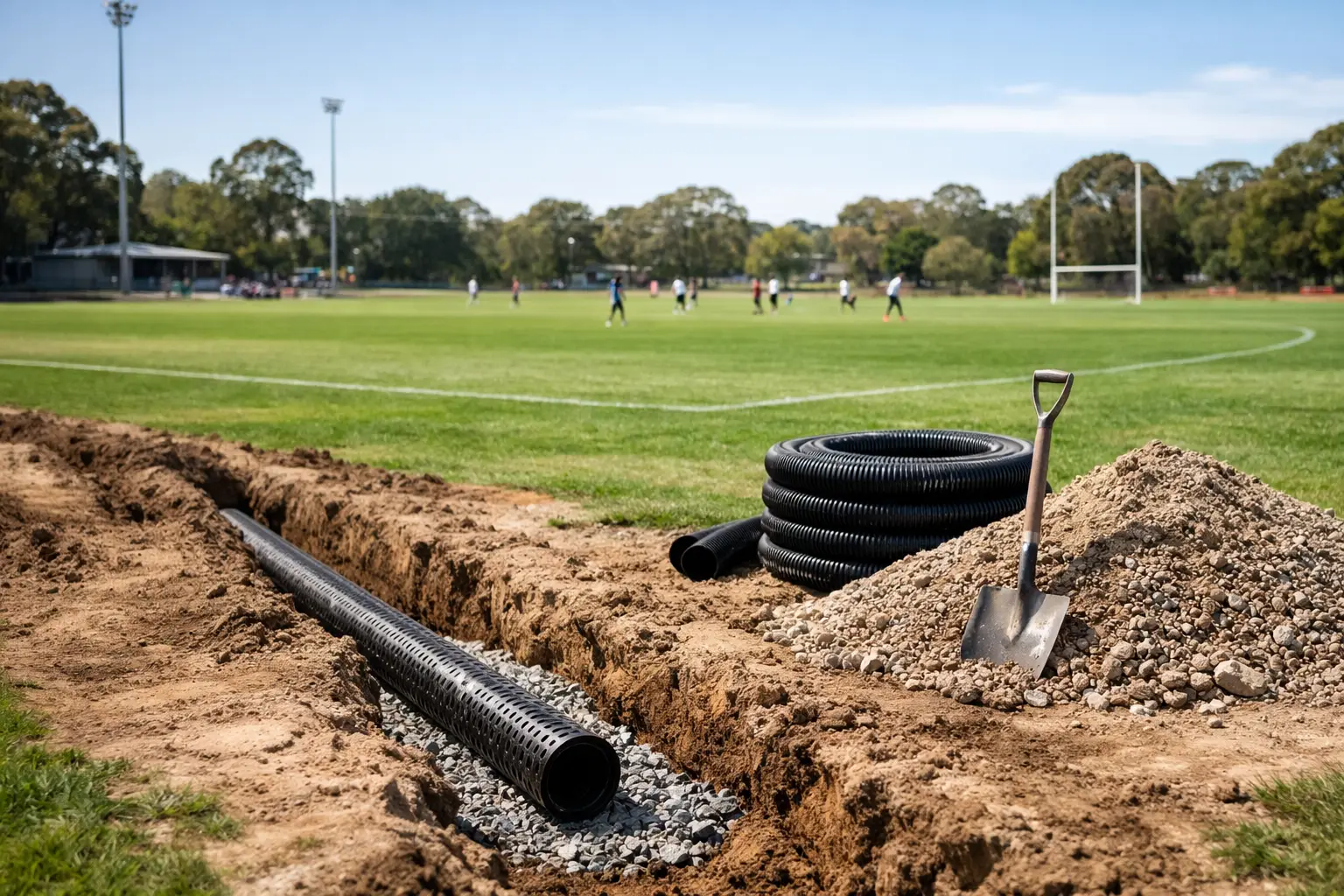
A wet weekend had become an operational problem, not just a weather problem. This sports oval drainage case study examines a common scenario for councils and community clubs: a heavily used natural turf field that held water after moderate rain, lost surface stability under traffic and attracted increasing complaints from players, hirers and ground staff. The issue was not simply that the oval was wet. It was that decisions about closures, repairs and capital works were being made without a clear diagnosis.
The following is a representative Australian community-sport scenario. It demonstrates how a structured assessment can separate surface symptoms from the underlying drainage constraints, protect capital expenditure and return an oval to more reliable use.
The operating problem
The oval hosted winter football, school sport, casual training and summer cricket preparation. Its maintenance team was competent but stretched. After rain, water pooled through one wing and along the low side of the centre square. Even when visible water had gone, the surface remained soft for days. Mowing caused wheel marks, line marking became difficult and fixtures were regularly moved or cancelled.
The first response had been predictable: apply more sand to the worst areas, aerate when conditions allowed and install a small amount of extra irrigation to help turf recover. These actions had merit, but they did not resolve the cause. Sand topdressing improved surface firmness temporarily, while cultivation could not overcome a high water table, blocked outlets or an inadequate fall to the discharge point.
For the facility manager, the risk extended beyond turf presentation. Repeated closures affected hire revenue and community confidence. Allowing play on unstable ground increased the likelihood of divots, compaction, player slips and a larger repair bill. The board needed an answer that was technically sound, affordable and easy to explain in a capital planning meeting.
Sports oval drainage case study: the diagnostic audit
Before recommending a drainage system, the project began with evidence. Drainage is often treated as a construction issue, but the first requirement is an accurate picture of how water enters, moves through and leaves the site.
The audit included a level survey across the playing surface and surrounding catchments, soil profile inspections, infiltration observations, irrigation checks and a review of existing pit, pipe and outlet locations. Historical rainfall, closure records and staff observations were also valuable. Ground staff could identify exactly where water first appeared, how long it persisted and which maintenance operations made the problem worse.
Three findings changed the direction of the project.
First, the oval had a very shallow crossfall. Water from the upper side migrated towards the low wing, but the surface did not have enough consistent grade to move rainfall efficiently into the perimeter collection system. Second, inspection pits revealed sediment and root intrusion in sections of the existing drainage line. Third, the soil profile contained a compacted layer beneath the topdressed surface. Water could enter the sandier upper profile but then perched above the denser layer after sustained rainfall.
This mattered because no single treatment would solve all three constraints. Installing new slits without correcting the outlet condition would move water towards a partially blocked system. Adding sand alone would improve the top 100 millimetres but leave the restrictive layer in place. Regrading without attention to subsurface movement could create a smoother-looking oval that still failed after prolonged rain.
The recommended scope: fix the water pathway
The preferred solution was targeted rather than excessive. Full reconstruction would have delivered the greatest level of certainty, but it would also have taken the oval out of service for a long period and required a capital budget beyond the facility's immediate capacity. It was not the only responsible option.
The staged works package focused on restoring the complete water pathway. It included cleaning and camera-inspecting the existing main lines, repairing damaged sections, rebuilding selected surface grades in the low wing, deep cultivation to relieve the compacted layer where profile testing supported it, and installing sand slits tied positively into functional collector drains. Perimeter spoon drains and inlets were also reshaped to prevent runoff from adjacent hardstand and footpaths entering the field.
The important word was positively. Every drainage component needed a verified fall to a discharge point. A sand slit or pipe that terminates without a reliable outlet is stored water, not drainage. This detail is easily missed when works are scoped from visual inspection alone.
The construction programme was scheduled immediately after the winter season. That timing reduced disruption, gave the new surface time to consolidate and allowed establishment work to be completed before high summer stress. It also required discipline: no premature return to heavy training simply because the surface looked green. Root development, surface firmness and turf cover had to meet agreed benchmarks before full use resumed.
Capital decisions require a whole-of-life view
The initial discussion centred on the cost of drainage works. The better discussion considered the cost of continuing as before.
The facility had been spending repeatedly on reactive repairs: patching worn areas, extra topdressing, contractor call-outs, additional labour after rain and fixture changes. Those costs were visible. Less visible were cancelled bookings, reputational damage and the gradual decline in staff morale when a known problem could not be fixed properly.
A capital recommendation should therefore compare at least three options: maintain the status quo, undertake targeted remedial drainage, or reconstruct the oval profile and drainage network. Each has a place. If the existing main drain is serviceable and the profile can be improved, targeted works may offer strong value. If the site has chronic groundwater pressure, severely unsuitable fill or no legal discharge pathway, reconstruction or broader civil works may be unavoidable.
The key is not to present a preferred solution as a guess. A board should receive a concise report that sets out the evidence, scope, risks, expected service life, programme impact and maintenance implications. That gives decision-makers a defensible basis for approving expenditure rather than reacting to the next washout.
Maintenance changed after construction
Drainage works are not a licence to return to business as usual. The oval's performance depended on how it was managed after handover.
Irrigation scheduling was adjusted to avoid keeping the profile unnecessarily wet. This is a common failure point: an improved drainage system can be undermined by irrigation applied according to habit rather than soil moisture, weather and plant demand. Application uniformity was checked so dry areas were not being overwatered in an attempt to support isolated weak zones.
The annual renovation programme was also redesigned. Hollow-tine aeration, sand topdressing and appropriate surface grooming were scheduled to preserve infiltration and maintain the connection between the surface and the drainage network. Machinery traffic was managed carefully during wet periods, particularly around player entry points and goalmouths where compaction returns quickly.
Ground staff received clear operating triggers. If rainfall reached a defined threshold, inspections focused on known low points, outlets and surface firmness before play was approved. This removed some of the uncertainty from closure decisions. Staff were no longer left to make high-pressure calls based solely on whether puddles were visible.
Measurable outcomes after the first full season
By the following winter, the oval was not immune to heavy rain. No natural turf surface should be promised as weather-proof. However, the waterlogging period after normal winter rainfall reduced substantially, the low wing no longer held standing water for extended periods and the surface returned to safe mowing conditions sooner.
The operational result was more important than a single drainage measurement. Fewer fixtures were relocated, recovery works were more predictable and the maintenance team spent less time repairing the same damaged areas. The facility could plan use with greater confidence because it understood the oval's limits and had evidence-based triggers for intervention.
There were trade-offs. Deep cultivation and surface regrading temporarily disrupted turf cover. The project required an off-season closure window and firm control over post-construction access. The capital cost was meaningful. But compared with recurring reactive expenditure and ongoing lost use, the works provided a more controlled path to improved availability.
What facility leaders should take from this case
Poor drainage is rarely just a drainage problem. It may involve surface levels, soil construction, irrigation practice, surrounding runoff, blocked infrastructure and traffic management. Treating only the most visible symptom usually creates repeat expenditure without fixing the constraint.
For clubs, councils and venue operators, the starting point should be a disciplined diagnostic audit, not a contractor quote based on a quick site walk. Independent advice is particularly valuable where significant capital works are proposed, because the recommended scope should serve the oval's long-term performance rather than a product or construction agenda.
A reliable sports oval is built through clear evidence, practical design and accountable maintenance. When those three elements are aligned, wet-weather management shifts from a weekly crisis to a controlled operational decision.