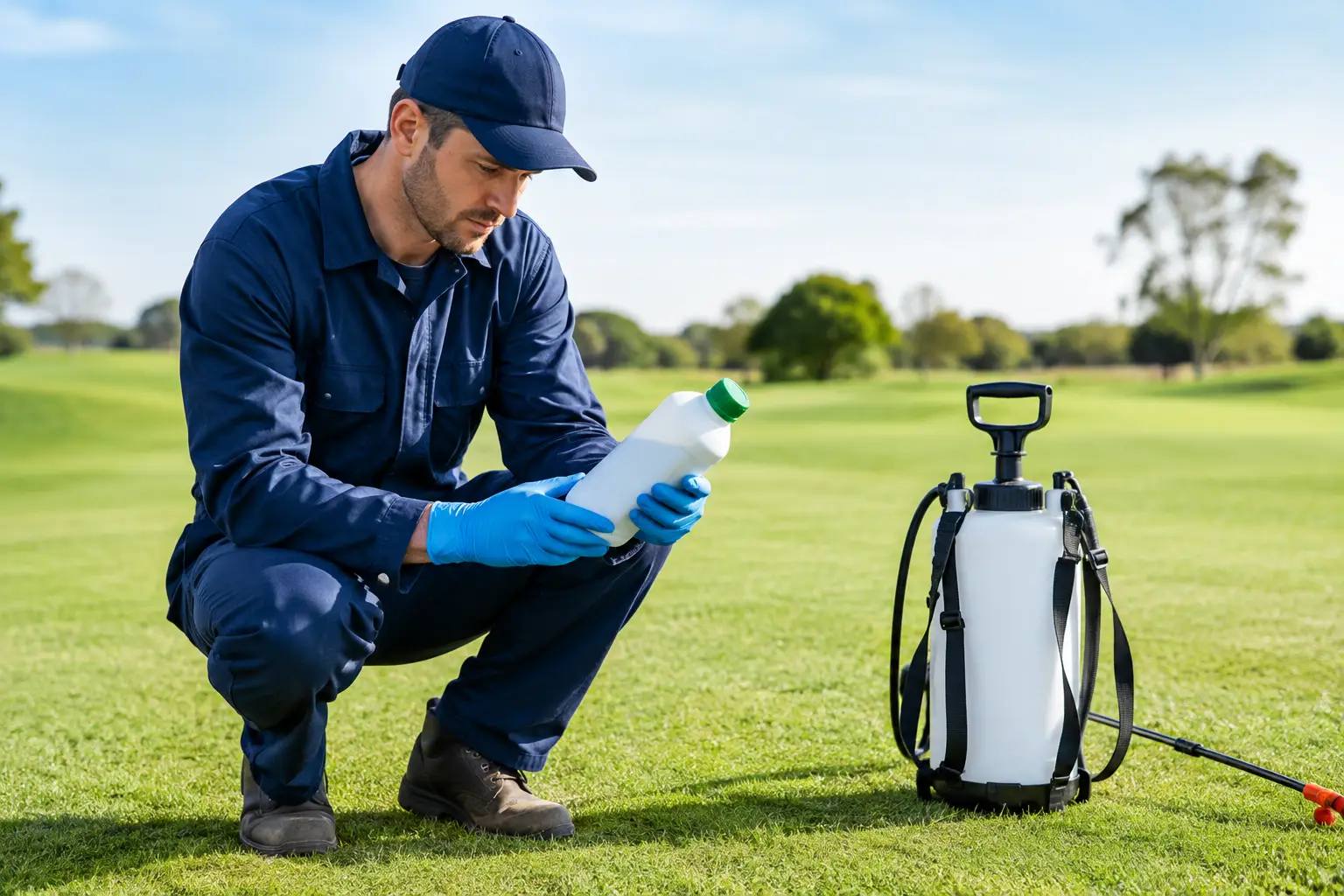
A herbicide drum in the chemical shed is not evidence of an approved turf program. For clubs, councils and sports facilities, the real question is who approves turf chemicals for the product, the intended use, the operator and the site. Those are separate controls, and confusing them creates avoidable compliance, environmental and reputational risk.
For Australian turf managers, the primary product regulator is the Australian Pesticides and Veterinary Medicines Authority, or APVMA. But APVMA registration is only the first gate. State rules, label directions, permits, staff competency requirements and the facility's own authorisation process determine whether a chemical can be used lawfully and responsibly on your site.
Who approves turf chemicals at the national level?
The APVMA assesses and registers agricultural and veterinary chemical products for sale and use in Australia. In a turf context, that commonly includes herbicides, fungicides, insecticides, plant growth regulators, wetting agents with pesticidal claims, and some other products used to manage pests or turf performance.
Registration means the APVMA has assessed the product for its stated uses, including efficacy, human health, residues and environmental risk. The product label is not marketing material. It is the approved set of instructions governing how that product may be used.
That label identifies the approved turf situations, target pests, application rates, timing, withholding or re-entry directions where relevant, personal protective equipment, buffer requirements, mixing instructions and disposal requirements. If turf is not listed as an approved use, a product being registered for another crop or setting does not automatically make it suitable for a fairway, bowling green, sportsfield or council reserve.
An APVMA registration number on the label confirms the product is registered. It does not give an operator blanket authority to apply it anywhere, at any rate, or under any site conditions.
Labels, permits and off-label use
A permit can allow a use that is not included on a product label, subject to strict conditions. APVMA permits may apply to a particular product, pest, location, industry group or period. They must be current, relevant to the intended application and held with the chemical records.
Do not treat a supplier recommendation, a social media post, or a practice used at another club as approval for an off-label application. A tank mix also requires scrutiny. Each product must be registered for the intended turf situation, used in accordance with its own label, and compatible with the other products in the mix. The absence of a specific tank-mix prohibition is not the same as proof that the combination is agronomically sound or safe for the turf.
State rules decide who can use turf chemicals
The APVMA approves the product and its registered use. State and territory governments regulate how agricultural chemicals are supplied, stored, handled and applied within their jurisdiction.
For facilities in Queensland, New South Wales and Victoria, the detailed requirements differ. Depending on the product, application setting and service arrangement, the relevant rules can cover operator licences or accreditation, recognised training, record keeping, notification, storage, transport and disposal. Public-place applications and higher-risk chemicals can attract additional controls.
This is especially relevant when a contractor is engaged to spray roughs, surrounds, playing fields, footpaths or public open space. A contractor's business registration or insurance is not, by itself, proof that every chemical application is compliant. The facility should verify that the operator has the required competency and authority for the work, and that the proposed products are approved for the specific use.
The practical position is straightforward: a registered product may still be used unlawfully if the person applying it is not appropriately authorised, if label conditions are ignored, or if state requirements have not been met.
The land manager still has an approval role
At club and council level, chemical approval is also a governance decision. The superintendent, course manager or contractor may nominate a treatment, but the organisation that controls the land remains accountable for its chemical program.
That accountability is often poorly defined. Grounds staff may be expected to make technical decisions without a documented authority limit, while a committee assumes the chemical shed is being managed correctly because the course looks presentable. That is not a system. It is an exposure.
A sound internal approval process should establish who can select products, who can authorise expenditure, who checks permits and labels, who applies chemicals, and who reviews records. For a small club, these functions may sit with only two or three people. The roles can be combined, but they should still be clear.
The board or general manager does not need to approve every spot spray. It should approve the chemical management framework, delegated authorities, annual budget and risk controls. The operational lead should approve treatment plans within that framework. This gives staff the authority to act while retaining governance visibility.
Fertilisers are not always regulated like pesticides
The term turf chemicals is broad. Not every product used on a turf surface requires APVMA registration. Conventional fertilisers, soil conditioners and many biostimulants may be regulated differently from pesticides, particularly where they make no pesticidal claim.
That distinction matters, but it should not lower management standards. Fertiliser applications can still create water-quality, turf-health and budget risks when rates, timing or irrigation are poorly managed. Products containing hazardous substances also require appropriate safety data sheets, storage, handling controls and worker training under work health and safety obligations.
A product marketed as natural, organic or biological should be assessed on its actual claims and ingredients, not its positioning. If it claims to control a pest, disease or weed, it may fall within agricultural chemical regulation. If there is uncertainty, verify its regulatory status before it enters the purchasing system.
A defensible approval process for clubs and facilities
The best chemical programs are not built around what is on special or what has always been used. They begin with a defined turf problem, a confirmed diagnosis and an outcome that can be measured.
Before approving an application, the responsible manager should be able to answer five questions:
- What is the pest, disease, weed or turf-performance issue, and how has it been identified?
- Is the proposed product registered for this turf use, or covered by a current permit?
- What do the label and state requirements demand of the operator, application method and records?
- What are the risks to people, waterways, neighbouring property, desirable turf and playing access?
- How will the result be assessed, and what is the next action if the treatment does not work?
This level of discipline prevents two common failures. The first is repeated reactive spraying without addressing the underlying cause, such as poor drainage, inadequate air movement, compaction, irrigation errors or nutrient imbalance. The second is chemical selection being driven by a product representative rather than site data and a documented agronomic plan.
Independent oversight has value here because it separates product choice from product sales. A treatment recommendation should stand up to scrutiny from the course team, the general manager and the board. It should identify the objective, rate, area, timing, cost, expected response and risk controls - not simply instruct staff to apply a drum from the shed.
Records are the evidence that matters
If an incident occurs, the question will not be whether the facility intended to do the right thing. The question will be whether it can demonstrate what was applied, by whom, where, when, at what rate and under what conditions.
Chemical application records should capture the product name, APVMA number where relevant, batch details if required, target area, application rate, total quantity used, weather conditions, operator details, equipment used and any re-entry or notification controls. Keep copies of current labels, permits, safety data sheets, training evidence and chemical inventory records in an accessible system.
Good records are more than a compliance file. They reveal seasonal disease pressure, recurring weed populations, product performance, annual chemical spend and opportunities to reduce unnecessary inputs. For boards managing rising maintenance costs, that information turns turf chemicals from an opaque operating expense into a controllable line item.
When expert oversight is worth the cost
A facility does not need a full-time superintendent to run an accountable chemical program. It does need someone with the authority and experience to connect chemical decisions to turf condition, irrigation performance, staff capability, budget and risk.
This is where fractional senior turf oversight can be commercially effective. Gen1 Sportsturf helps facilities establish practical standards around chemical compliance, treatment planning and operational accountability while allowing existing staff to carry out the work. The objective is not more spraying. It is better decisions, fewer avoidable applications and turf performance that can be explained with confidence.
The next time a chemical purchase reaches the approval desk, ask for more than a price and a product name. Ask for the turf problem, the label position, the application plan and the evidence that the treatment is the right use of the club's money.