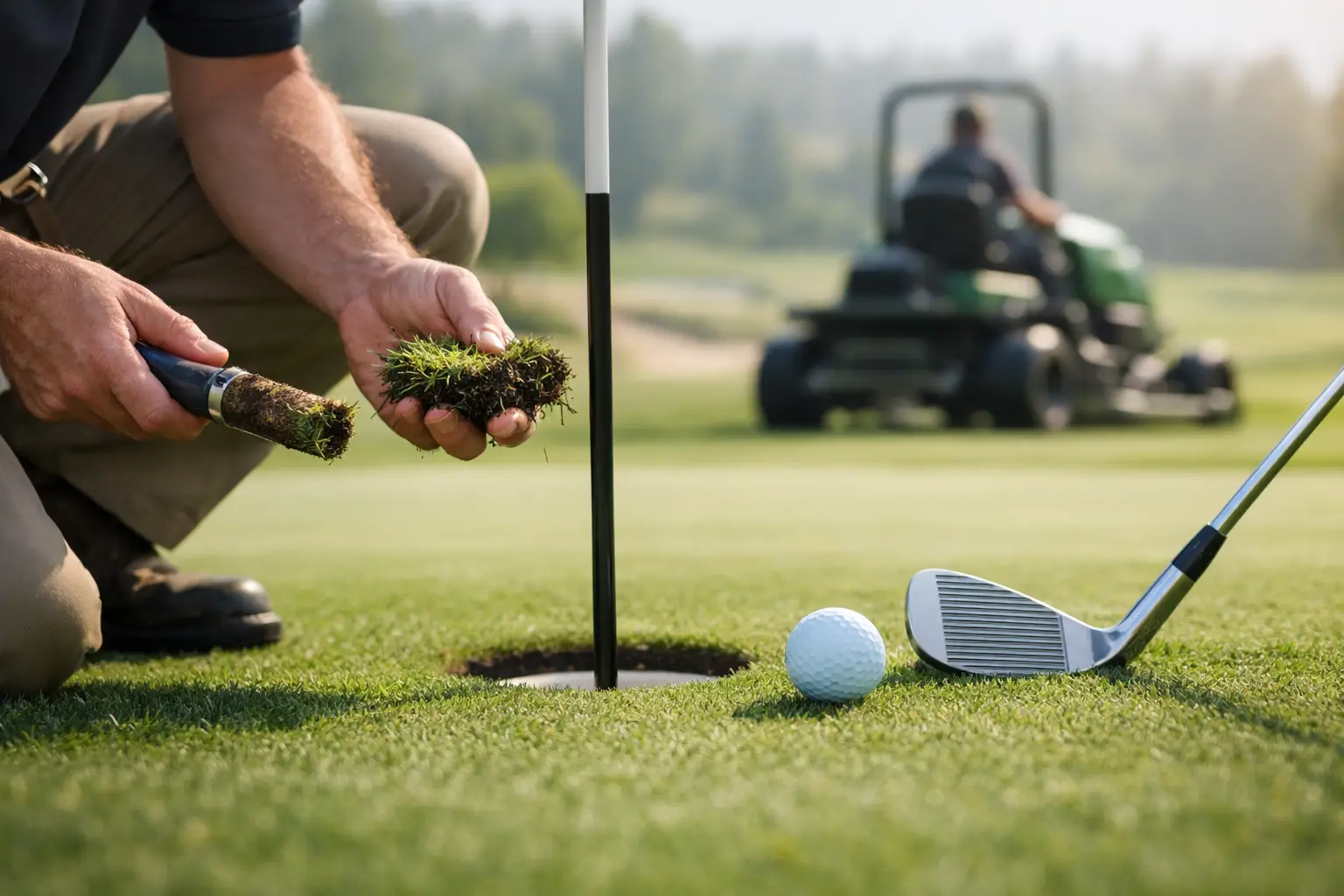
A golf club turf strategy is not a seasonal maintenance calendar dressed up for a board meeting. It is the operating framework that decides how a club protects playing quality, spends its maintenance budget, manages water and gives its team clear priorities when conditions become difficult.
For many clubs, turf performance is judged only when it fails. Greens lose consistency, fairways thin out, irrigation costs rise, members complain, and the committee asks what happened. By that point, the facility is reacting to a problem that has usually been building through weak planning, unclear accountability or deferred investment.
A disciplined strategy changes that position. It connects agronomy with commercial reality, so the course team can make decisions that are defensible, measurable and aligned with the club's standard of presentation.
Why golf club turf strategy belongs at board level
Turf is one of a club's largest operational assets and one of its most visible member experiences. Yet it is often managed as a technical function sitting outside broader business planning. That creates a gap between what the course needs and what the board believes it is funding.
The board does not need to prescribe fertiliser rates or choose a wetting agent. It does need confidence that the maintenance programme has a clear standard, that risks are identified early, and that money is being directed to the work with the strongest impact on playability and asset protection.
A sound strategy answers practical questions: What playing standard is the club committing to? What does that standard cost under normal and adverse weather conditions? Where is the irrigation system most exposed? Which areas can accept a lower input level without damaging member satisfaction? Who owns each decision when conditions change?
Without these answers, budgets tend to be based on last year's spend plus a small adjustment. That is not strategy. It is a recipe for recurring surprises.
Start with the course the club can realistically sustain
Every club wants firm, consistent surfaces and strong visual presentation. The relevant question is whether the club has the water, labour, equipment, infrastructure and budget to produce that result reliably.
A high-expectation private club, a regional member club and a public-access facility may all require quality turf, but their acceptable standards and operating constraints will differ. Trying to maintain championship conditioning across every hectare, every month of the year, is rarely the best use of resources. It can also create unnecessary water demand, staff pressure and chemical exposure.
The strategic starting point is to define performance standards by area. Greens, tees, fairways, roughs, practice areas, surrounds and non-playing landscapes should not receive the same level of input by default. Each area should have an agreed purpose, presentation target and response plan for dry, wet or high-traffic periods.
This is where trade-offs need to be made openly. A club may choose to prioritise greens consistency and key landing areas during water restrictions, while allowing selected roughs or out-of-play areas to become less manicured. That is not a reduction in standards. It is disciplined allocation of finite resources.
Build standards around measurable outcomes
Vague expectations such as “keep the course looking good” leave the superintendent or grounds team exposed. Better standards describe the outcomes that matter: green speed range, firmness, disease tolerance, surface uniformity, irrigation efficiency, bunker presentation, mowing frequency and recovery time after weather events.
Not every measure needs to appear in a monthly board report. However, the operational team should know what is being measured and why. Consistent data makes it easier to distinguish a weather-driven issue from a planning failure, and it gives the board a credible basis for funding decisions.
Water is a strategic asset, not a maintenance line item
Across Queensland, New South Wales and Victoria, water availability and cost can reshape a course's maintenance programme quickly. Irrigation systems are often expected to compensate for poor soil conditions, inadequate drainage, uneven coverage or a lack of moisture monitoring. That approach is expensive and rarely sustainable.
An effective golf club turf strategy assesses the whole water system: supply security, storage, pump capacity, irrigation uniformity, controller capability, soil moisture, drainage and the team's ability to respond to localised dry spots. It also identifies where water is being applied without a proportionate benefit to playing surfaces.
A water audit can reveal issues that daily visual inspections miss. Inconsistent nozzle performance, pressure variation, blocked heads and poor scheduling may lead to overwatering in one area while another remains under stress. The result is not only higher consumption. It can mean softer surfaces, disease pressure, weak roots and greater labour demand.
The strategic objective is not simply to use less water. It is to apply the right amount, in the right place, at the right time, while preserving turf health and playability. That requires irrigation decisions to be based on field conditions and verified performance, not habit.
Protect the budget by planning work before it becomes urgent
Emergency spending is usually the most expensive form of spending. A failed pump, widespread disease outbreak, unsafe tree, worn-out mower fleet or major drainage issue can force a club into decisions made under pressure. Some events cannot be avoided, but many can be anticipated.
The maintenance budget should separate recurring operational costs from renewal and capital needs. Labour, fertiliser, chemicals, fuel, utilities and routine repairs belong in the operating plan. Irrigation renewal, machinery replacement, drainage upgrades and major renovation works need a longer horizon, with condition assessments and realistic timing.
A useful strategy usually works across three timeframes. The annual plan directs seasonal maintenance and current-year expenditure. A three-year plan addresses known risks, staff capability and priority upgrades. A five to ten-year asset plan gives the board visibility of major infrastructure decisions before failure dictates the timing.
This structure prevents capital requirements from being buried in a maintenance budget that is already under pressure. It also allows management to explain why a targeted upgrade may reduce future labour, water or repair costs.
Give the team clear authority and support
Good turf strategy does not replace the grounds team. It gives them a stronger operating environment. Staff need defined priorities, practical procedures, appropriate training and access to experienced leadership when complex agronomic or operational decisions arise.
Where a club has lost a superintendent, is carrying an inexperienced team or cannot justify a full-time senior appointment, the leadership gap can quickly affect standards. Staff may work hard but lack the authority to reset programmes, challenge supplier recommendations, manage compliance or present technical risks to the board.
Independent oversight is valuable because it brings objectivity to those decisions. Advice should be based on the site, the club's goals and verified data, rather than a product sales target. It should also include mentoring, so the existing team becomes more capable rather than more dependent.
Gen1 Sportsturf applies this model through strategic direction, diagnostic review and regular accountability, allowing club teams to execute a clear plan with senior turf leadership behind them.
Report the decisions, not just the activity
Boards do not need a report listing every mowing hour or product application. They need a concise view of course condition, expenditure against plan, material risks, upcoming decisions and the operational actions being taken.
The strongest reporting links technical matters to club outcomes. For example, an irrigation uniformity issue should be reported as a risk to playing consistency, water cost and long-term infrastructure reliability. A fungal disease programme should identify the surface risk, treatment rationale, budget impact and any relevant chemical compliance controls.
This style of reporting improves governance because it makes accountability visible. It also prevents the course team from being judged solely on appearance after a difficult weather period. If a risk was identified, a response was approved and results are tracked, the club is managing turf as a professional asset.
Review the strategy when conditions change
A strategy should be stable enough to guide decisions but flexible enough to respond to reality. Extended heat, flooding, water restrictions, changing membership expectations, a major event programme or staff turnover can all require a reset.
At least annually, the club should review whether its stated standards still match its financial capacity and operational resources. This is also the right time to assess asset condition, irrigation performance, chemical compliance, contractor arrangements and staff development needs.
The best time to make a difficult turf decision is before the course is under visible stress. A clear strategy gives boards and operational teams the confidence to act early, protect the surfaces that matter most and explain the rationale to members with authority.