A superintendent resignation, worsening playing surfaces or an irrigation bill that keeps climbing usually forces the same boardroom question: do we recruit, or do we seek outside expertise? The turf consultant versus superintendent decision is not simply about who knows more about grass. It is a decision about leadership structure, budget, risk and the level of day-to-day control your facility genuinely needs.
For many golf clubs, bowling clubs, councils and sports venues, a full-time superintendent remains the right appointment. For others, particularly facilities with capable on-ground staff but no senior strategic leadership, a fractional consultant can deliver stronger oversight at a far lower fixed cost. The right answer depends on operational complexity, staff capability and the standard of turf performance expected.
Turf consultant versus superintendent: the core difference
A superintendent is an embedded operational leader. They are responsible for the daily condition of the course or venue, the work programme, labour allocation, machinery, irrigation response, chemical use, budgets and stakeholder communication. They make decisions on site, often several times a day, and carry direct accountability for the finished surface.
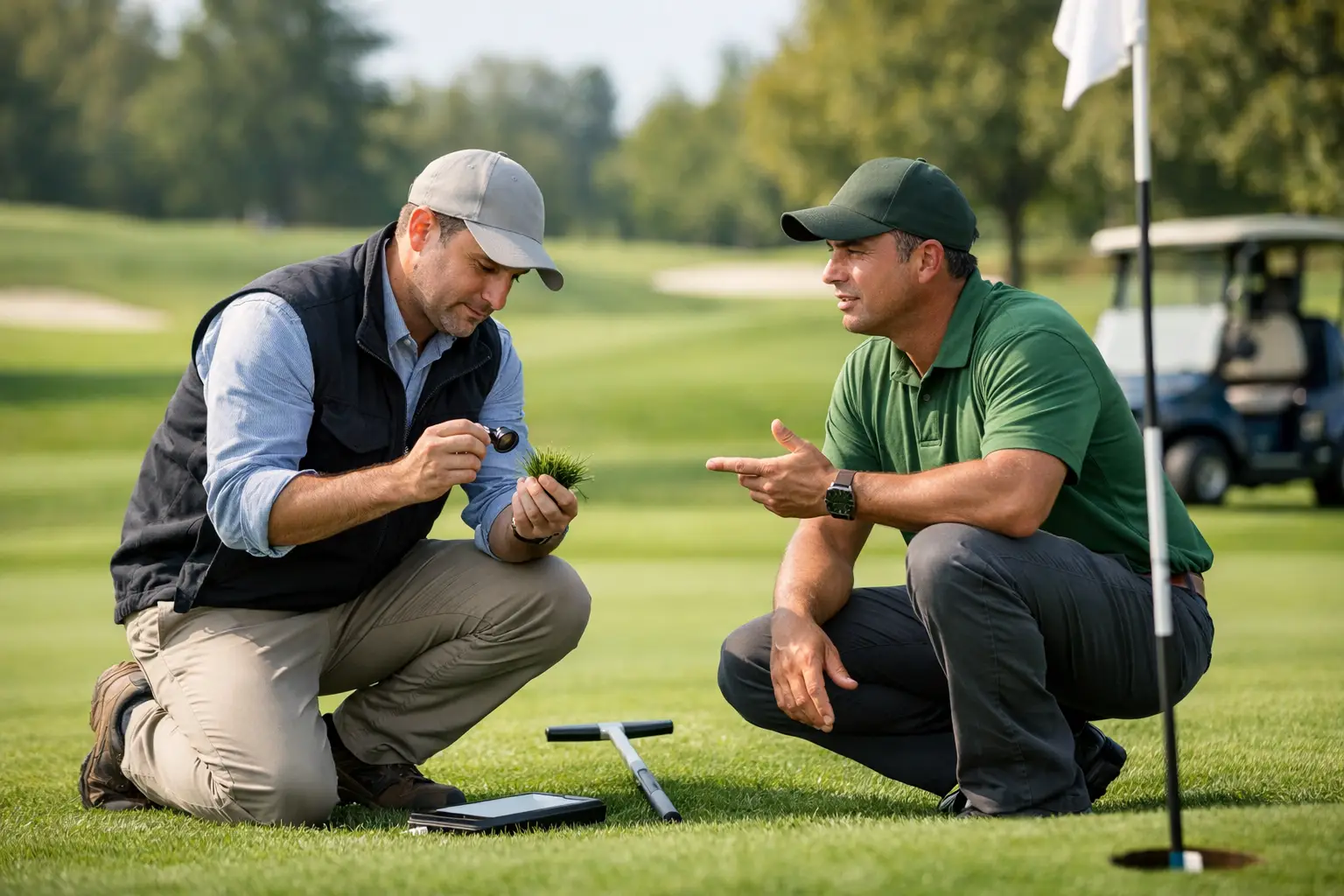
A turf consultant provides senior technical and strategic direction without occupying that full-time operational role. Their value is in diagnosing problems, setting standards, developing maintenance plans, analysing irrigation performance, reviewing inputs and mentoring the team responsible for execution. A consultant should bring independent advice and a clear reporting line to the general manager, board or committee.
The distinction matters because neither model is a lighter version of the other. A consultant cannot be expected to replace the daily presence of a superintendent where the facility has no competent supervisor, no reliable staff or a highly demanding event calendar. Equally, employing a full-time superintendent can be an expensive solution where the real gap is strategic planning, accountability and specialist knowledge.
What a full-time superintendent delivers
At a busy golf club or major sports venue, the superintendent is the operational centre of the turf department. They set daily priorities when weather changes, machinery breaks down, irrigation faults emerge or disease pressure rises. They also manage staff performance in real time and make sure standards do not drift between board meetings.
This model works best when turf is a major operational function with substantial labour, extensive irrigation infrastructure, multiple playing surfaces or a year-round demand for high presentation. It is particularly valuable where a club needs a visible leader who can deal directly with members, contractors and management each day.
The trade-off is cost and recruitment risk. A capable superintendent is a senior appointment, not just a greenkeeping position. Salary, superannuation, leave, vehicle allowances, recruitment costs and professional development can make the true annual cost materially higher than the advertised salary. In a tight labour market, the risk does not end once a candidate accepts the role. A poor appointment, or a prolonged vacancy, can quickly affect surface quality, staff morale and member confidence.
A superintendent also needs the right governance environment. If committees regularly override technical decisions, defer essential capital works or demand championship conditions without supporting the required budget, even the strongest operator will struggle to deliver consistent results.
Where a turf consultant creates better value
A consultant is most effective when a facility needs senior judgement but does not need, or cannot justify, a full-time executive turf salary. This is common in regional clubs, bowling clubs, council-managed facilities and venues where an experienced grounds team already completes routine work but lacks strategic direction.
The consultant establishes the operating framework. That may include a seasonal maintenance plan, fertiliser and chemical programme, irrigation audit, disease prevention strategy, machinery replacement priorities and a realistic budget tied to the required standard of play. The on-site team then executes the programme with ongoing support, review and accountability.
This arrangement is not about handing over a report and hoping for the best. Effective fractional leadership requires regular site inspections, clear work priorities, practical coaching and concise board-level reporting. It should identify what is working, what is at risk and what decisions management must make before a minor issue becomes a costly failure.
The commercial advantage is straightforward. Instead of carrying a full-time senior salary, a facility buys the level of expertise and access it needs through a defined monthly retainer. That releases funds for the work that actually improves the asset: irrigation repairs, drainage, soil testing, staff training, plant replacement or targeted agronomic inputs.
Independence is another advantage. A consultant who is not selling chemicals, fertiliser, irrigation equipment or contract labour can assess options on their merit. Recommendations should be based on turf performance, whole-of-life cost and operational practicality, not supplier incentives.
The question is not title. It is accountability.
Boards sometimes frame the decision as consultant versus employee. That is too narrow. The more useful question is: who owns the plan, who checks that it is being delivered, and who has authority to correct course when conditions change?
A full-time superintendent has direct operational authority. Their accountability is visible every day. A consultant works through an agreed governance model, which must be explicit from the start. The consultant provides the strategic plan and technical direction; the nominated on-site manager or leading hand owns daily implementation; management and the board provide timely decisions on budget and capital priorities.
Without this structure, a consultancy arrangement can fail. If recommendations sit in meeting minutes, staff receive conflicting instructions, or no one owns the daily programme, the facility has bought advice rather than leadership. That is not a consultant problem alone. It is a governance failure.
A strong engagement sets out inspection frequency, reporting cadence, delegated authority, response expectations and measurable performance indicators. These may include water use, disease incidence, surface firmness, presentation standards, budget variance, staff training progress and completion of agreed maintenance tasks.
Cost should be measured against risk, not salary alone
The visible salary comparison is only one part of the decision. Poor turf outcomes carry their own costs: lost rounds, dissatisfied members, cancelled events, water waste, emergency chemical applications, premature machinery spend and reputational damage. A brown or inconsistent playing surface tells members that standards are slipping, whether the cause is staffing, irrigation or planning.
There is also the cost of reactive management. Facilities without a documented programme often spend heavily in response to symptoms. They apply product after disease appears, repair irrigation after dry spots develop, or replace equipment only once failures disrupt operations. Planned maintenance is rarely glamorous, but it is more controllable than crisis spending.
A consultant-led model can be commercially compelling when it prevents those decisions and directs limited capital to the highest-value priorities. It is not automatically cheaper in every circumstance. If the site requires daily senior oversight, relying on periodic visits can create a false economy. The savings disappear when no one is available to manage staff, weather events or urgent operational issues.
A practical way to choose the right model
Start with the condition of the existing team. If you have a capable course manager, leading hand or grounds supervisor who can run daily work but needs senior technical support, a consultant can lift capability quickly. If the team lacks a reliable operational leader altogether, recruit a superintendent or appoint an experienced interim manager before expecting a consultant to solve every gap.
Next, assess the asset and the demand placed on it. A 36-hole club with a large maintenance operation, ageing irrigation and major event commitments has different needs to a community bowling club or a council reserve. The more moving parts there are each day, the stronger the case for an embedded superintendent.
Then examine the quality of your information. Can the board see current water use, chemical records, maintenance costs, irrigation faults, planned works and surface performance? If not, the immediate need may be a diagnostic audit and a management system, rather than another ad hoc purchase or a rushed recruitment process.
Finally, be honest about governance. Senior turf professionals need clear authority, realistic budgets and agreed performance standards. A facility that expects elite conditions on a restricted budget must decide what it will compromise: presentation, resilience, labour, capital investment or playing access. No staffing model can remove that trade-off.
A fractional model needs the right foundation
Gen1 Sportsturf works best where facilities want championship-grade standards, but require a commercially disciplined way to access senior leadership. The process begins with understanding the site, the team, the infrastructure and the financial position. From there, the priority is a practical plan that the existing staff can deliver, supported by regular oversight and reporting that gives boards confidence in the direction of travel.
The objective is not to make the grounds team dependent on an external adviser. It is to give them clearer systems, stronger technical support and defined standards. Over time, that capability becomes part of the facility's operating strength.
The best decision is the one that puts accountable leadership closest to the risk. If your venue needs daily command, appoint a superintendent and support them properly. If it needs experienced strategic direction, independent scrutiny and a disciplined plan without the burden of a full-time executive role, a fractional turf consultant may be the more responsible investment.